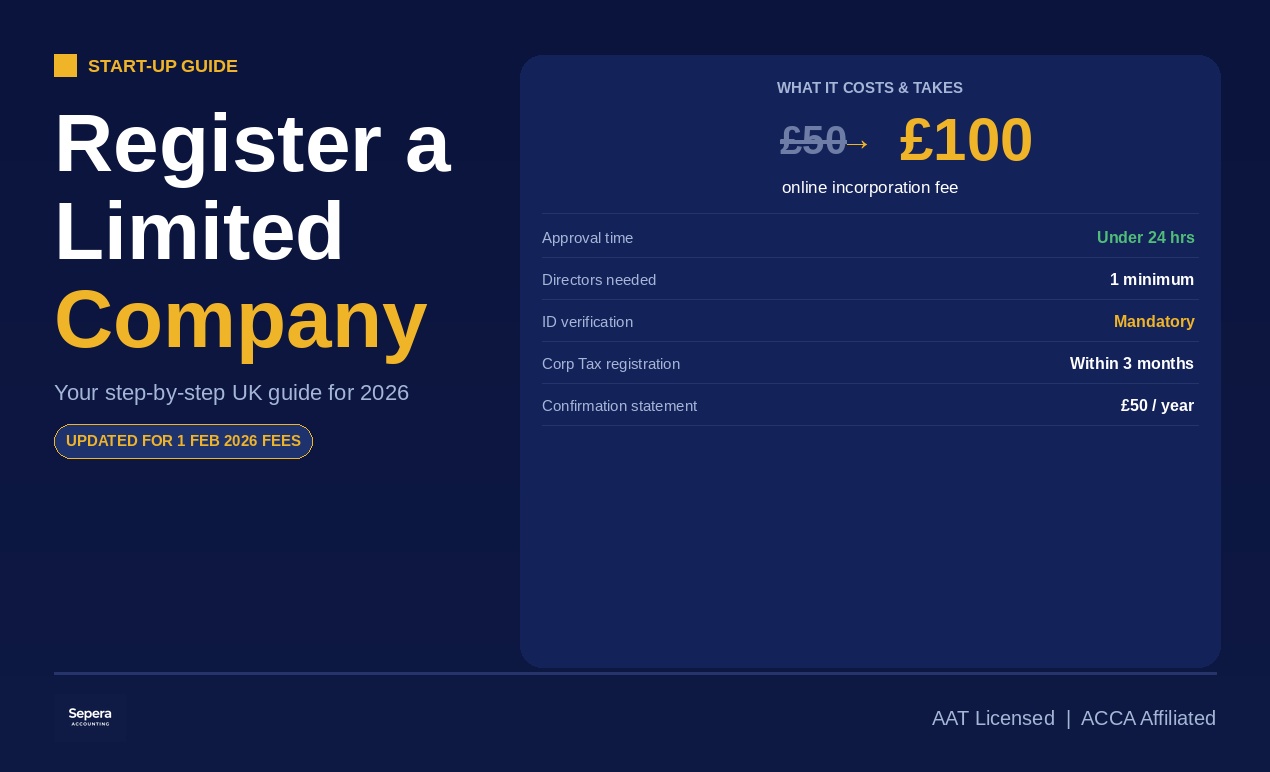
 To register a limited company in the UK, you incorporate it with Companies House, which as of 1 February 2026 costs £100 online and can be completed in under 24 hours. That part is genuinely quick. What trips people up is everything around it: choosing the right structure, getting share allocations right from the start, meeting the new identity verification rules, and knowing which tax registrations follow and when.
This guide walks through the whole process step by step, covers what changed in 2026, and sets out what you need to do in the weeks after incorporation. At Sepera Accounting, our start-up support and registration service handles this end to end, but this guide gives you the full picture whether you do it yourself or not.
Should You Register a Limited Company at All?
Before you register a limited company, it is worth being sure the structure is right for you. A limited company is a separate legal entity from its owners, which brings limited liability protection, potential tax efficiency, and greater credibility, but also more administration and public disclosure than operating as a sole trader.
As a rough guide, incorporation often starts to make financial sense at consistent annual profits above roughly £30,000 to £35,000, though the decision depends on far more than profit alone. We cover the full comparison in our guide to sole trader vs limited company. If you are confident a company is right for you, read on.
What You Need Before You Register a Limited Company
Have the following ready before you start the application:
- A company name that is unique and not too similar to an existing registered name, and that does not use restricted or sensitive words without permission
- A registered office address in the UK, which will be publicly visible on the register
- At least one director aged 16 or over
- At least one shareholder (this can be the same person as the director)
- Details of people with significant control (PSCs), typically anyone holding more than 25% of shares or voting rights
- A SIC code, which describes your company’s main business activity
- Details of your share structure, including how many shares are issued and to whom
Step by Step: How to Register a Limited Company
- Verify your identity. Since 18 November 2025, identity verification is mandatory for all new directors and people with significant control. This is a compliance step rather than an extra fee, but it must be completed as part of the process.
- Choose and check your company name. Use the Companies House name availability checker to confirm your chosen name is free and permitted.
- Go to the Companies House Web Incorporation Service. This is the quickest and cheapest route, available through GOV.UK.
- Enter your company details. Company name, registered office address, directors, shareholders, PSCs, and SIC code.
- Set your share structure. Decide how many shares to issue and to whom. For a single-owner company, a single £1 ordinary share is common, but the right structure depends on your plans, especially if you have a business partner or intend to bring in investment.
- Choose your articles of association. Most new companies use the standard model articles unless they have specific reasons to customise.
- Pay the £100 fee and submit. Standard online incorporation is typically approved within 24 hours.
- Receive your Certificate of Incorporation. Once approved, your company legally exists, and you will receive your company registration number.
What It Costs to Register a Limited Company in 2026
Companies House increased its fees on 1 February 2026. The current statutory fees are:
- Standard online incorporation: £100 (up from £50)
- Same-day online incorporation: £156
- Paper (postal) incorporation: £124
There is no separate government charge for identity verification when you register directly. If you use a formation agent or accountant, their fee typically bundles the £100 Companies House cost with document preparation, share structure advice, and initial tax setup. You can check the current figures on the official GOV.UK limited company formation guidance.
What Changed for Company Registration in 2026
Two significant changes affect anyone looking to register a limited company right now.
Mandatory identity verification. Under the Economic Crime and Corporate Transparency Act, identity verification became mandatory for new directors and PSCs from 18 November 2025. This is part of a wider drive to improve the reliability of the Companies House register and reduce fraud. It adds a step to the process rather than a direct cost.
Higher fees. The doubling of the incorporation fee to £100, alongside the annual confirmation statement rising to £50, means both starting and maintaining a company now costs more than it did in 2025. These remain low by international standards, but they are worth factoring into your start-up budget.
What to Do After You Register a Limited Company
Incorporation is the beginning, not the end. Once your company exists, several important steps follow, some with strict deadlines.
Register for Corporation Tax. You must register with HMRC within three months of starting to trade. Miss this and you risk penalties.
Open a business bank account. A company is a separate legal entity, so its finances must be kept separate from your personal money. A dedicated business account is essential, not optional.
Set up your accounting records. You will need to maintain statutory registers and keep accurate financial records from day one to meet your reporting obligations.
Understand your filing duties. Every company must file annual accounts and a confirmation statement with Companies House, plus a Corporation Tax return with HMRC. Our limited company accounting service handles all of these deadlines for you.
Consider VAT and payroll. If your turnover will exceed the £90,000 VAT threshold, you will need to register for VAT, covered in our guide to the VAT registration threshold. If you plan to pay yourself or staff a salary, you will also need to set up PAYE payroll.
Plan how you will pay yourself. Most director-shareholders take a mix of salary and dividends. Getting this right from the start is one of the biggest tax-efficiency levers available, explained in our guide to salary vs dividends.
Common Mistakes When You Register a Limited Company
Getting the share structure wrong. Issuing shares badly at the outset, particularly with a business partner, can cause serious problems later around control and profit splits. This is one of the hardest things to unwind after the fact.
Using your home address as the registered office without thinking. The registered office is publicly visible on the register. Many directors prefer to use an accountant’s or a service address instead for privacy.
Forgetting the Corporation Tax registration deadline. The three-month window from starting to trade is easy to miss when you are focused on actually running the business.
Choosing the wrong SIC code. While not catastrophic, an inaccurate SIC code can cause confusion and occasionally affect things like insurance or banking.
How Sepera Accounting Helps You Register a Limited Company
You can absolutely register a limited company yourself directly with Companies House. Where an accountant adds value is everything around the filing: advising on whether incorporation is right for you at all, structuring shares correctly from the outset, handling identity verification, setting up your tax registrations on time, and making sure you do not miss the deadlines that carry penalties.
We are an AAT-licensed, ACCA-affiliated practice with over 30 years of combined experience helping businesses across London and Stockport get started correctly. Our start-up support service takes care of the whole process. Get in touch via our contact page or call +44 20 7071 8676.
Frequently Asked Questions: Register a Limited Company
How much does it cost to register a limited company in the UK?
As of 1 February 2026, standard online incorporation with Companies House costs £100. Same-day online incorporation is £156, and paper incorporation is £124. These are one-off statutory fees set by the government.
How long does it take to register a limited company?
Standard online registration is typically approved within 24 hours of a complete and correct application. Same-day incorporation is available for £156 if submitted before the daily cut-off time.
Can I register a limited company myself?
Yes. You can register directly through the Companies House Web Incorporation Service on GOV.UK for £100. Many people use an accountant or formation agent instead for advice on share structure, tax registration, and to ensure the application is error-free.
Do I need to verify my identity to register a limited company?
Yes. Since 18 November 2025, identity verification has been mandatory for all new directors and people with significant control, under the Economic Crime and Corporate Transparency Act. It adds a step to the process but no separate government fee.
What do I need to register a limited company?
You need a unique company name, a UK registered office address, at least one director aged 16 or over, at least one shareholder, details of people with significant control, a SIC code, and your share structure.
What is a SIC code?
A SIC (Standard Industrial Classification) code describes your company’s main business activity. You select the most appropriate code during registration, and it appears on the public register.
What do I need to do after registering a limited company?
Register for Corporation Tax with HMRC within three months of starting to trade, open a business bank account, set up accounting records, and understand your filing duties for annual accounts, the confirmation statement, and your Corporation Tax return.
When do I need to register for VAT after forming a company?
You must register for VAT once your taxable turnover exceeds £90,000 in a rolling 12-month period. Some companies register voluntarily earlier to reclaim VAT on purchases or to appear more established to clients.
Can I use my home address when I register a limited company?
Yes, but the registered office address is publicly visible on the Companies House register. Many directors prefer to use an accountant’s address or a dedicated service address to keep their home address private.
Is it better to be a sole trader or register a limited company?
It depends on your profits and circumstances. Incorporation often becomes financially attractive at consistent profits above roughly £30,000 to £35,000, offering limited liability and potential tax efficiency, but it also brings more administration and public disclosure than operating as a sole trader.
This article provides general guidance on how to register a limited company in the UK in 2026. Fees and rules can change. Please contact us for advice tailored to your specific situation.