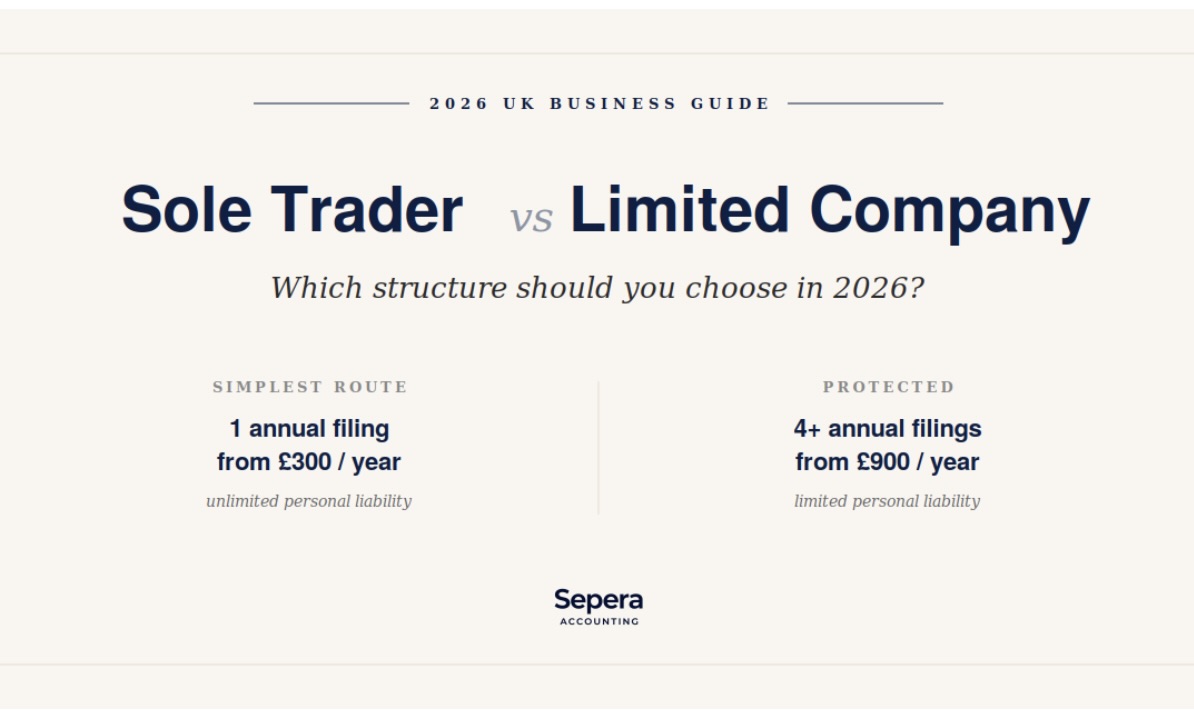
 The sole trader vs limited company UK question is one of the most important decisions you’ll make as a business owner. The structure you pick affects how much tax you pay, how much paperwork you handle, how much personal risk you carry, and how the outside world sees your business.
There is no single answer that works for everyone. The right answer to the sole trader vs limited company UK debate depends on your profit level, your appetite for admin, the risk in your industry, and where you want to take the business over the next five years.
In this 2026 guide to sole trader vs limited company UK, we break down the real differences between the two structures. By the end, you’ll know which one fits your business now, when to consider switching, and how to make the change cleanly if you decide to.
Sole Trader vs Limited Company UK: Quick Comparison at a Glance
Before we go deep into the sole trader vs limited company UK debate, here’s how the two structures compare side by side.
| Feature | Sole Trader | Limited Company |
|---|---|---|
| Legal status | You and the business are the same | Separate legal entity |
| Personal liability | Unlimited | Limited to shareholding |
| Tax paid | Income Tax + National Insurance | Corporation Tax + tax on dividends and salary |
| Setup cost | Free | From £12 (Companies House fee) |
| Setup time | Minutes | 24 hours typically |
| Annual filings | 1 Self Assessment return | Annual Accounts, Confirmation Statement, CT600, Self Assessment |
| Accounts public? | No, kept private | Yes, filed at Companies House |
| Typical accounting fees | £300 to £900 per year | £900 to £2,400 per year |
| Best for | Low-risk businesses under £40k profit | Higher profit, higher-risk, or growth businesses |
What is a Sole Trader?
A sole trader is a self-employed individual who owns and runs their own business. Legally, the business and the person are the same entity. There is no separation between your business assets and your personal assets.
Key features of being a sole trader in the UK:
- You keep all the profits after tax
- You are personally responsible for all business debts
- You report income through Self Assessment to HMRC
- Setup is fast and free
- Paperwork is minimal
- Your accounts stay private
Sole traders pay Income Tax and Class 2 / Class 4 National Insurance on profits. The Income Tax bands for the 2026/27 tax year are:
- Personal allowance: £12,570 (tax-free)
- Basic rate: 20% on profits from £12,571 to £50,270
- Higher rate: 40% on profits from £50,271 to £125,140
- Additional rate: 45% on profits above £125,140
For most small businesses weighing up sole trader vs limited company UK options at the start, sole trader is the simplest, cheapest, and most flexible way to operate.
What is a Limited Company?
A limited company is a separate legal entity from the people who own and run it. The company owns its own assets, takes on its own debts, and pays its own taxes. You become a director (and usually a shareholder) of the company rather than being the business yourself.
Key features of a UK limited company:
- The business is its own legal entity
- Your personal liability is limited to the value of your shares
- The company pays Corporation Tax on profits
- You can pay yourself a combination of salary and dividends
- Annual accounts and a Confirmation Statement must be filed at Companies House
- Your accounts become public record
- You usually need an accountant
Limited companies pay Corporation Tax on profits at:
- 19% for profits up to £50,000 (Small Profits Rate)
- 25% for profits above £250,000 (Main Rate)
- Between 19% and 25% on profits in between (Marginal Relief applies)
Directors typically extract money from the company through a combination of a low salary and dividends. This is one of the key sole trader vs limited company UK tax differences, and it’s usually more tax-efficient than drawing a high salary. We cover this in detail in our guide to salary vs dividends in 2026.
Sole Trader vs Limited Company UK: The Real Tax Difference
Tax is usually the biggest factor in the sole trader vs limited company UK decision. Here’s how the numbers play out at three profit levels for the 2026/27 tax year, assuming a director takes a typical salary plus dividends in a limited company.
At £25,000 profit:
- Sole trader: roughly £3,000 to £3,500 total tax and NI
- Limited company: roughly £3,500 to £4,000 once Corporation Tax, dividend tax, and accounting fees are factored in
At this level, the sole trader option is usually slightly better, and the simpler admin makes it the clear winner.
At £50,000 profit:
- Sole trader: roughly £11,000 to £12,000 total tax and NI
- Limited company: roughly £9,500 to £10,500 total tax
The limited company starts to pull ahead, but the gap is small once you factor in extra accounting fees.
At £100,000 profit:
- Sole trader: roughly £32,000 to £34,000 total tax and NI
- Limited company: roughly £25,000 to £28,000 total tax
The limited company is now clearly more tax-efficient, saving £5,000 to £8,000 a year.
The general sole trader vs limited company UK rule: as profits rise above about £40,000 to £50,000, a limited company starts to make sense from a tax perspective. Below that, the savings often don’t justify the extra paperwork and accounting fees.
But tax isn’t everything. There are several other factors that matter just as much.
Sole Trader vs Limited Company UK: Personal Liability
Liability is where the two structures differ most dramatically.
Sole trader liability is unlimited. You and the business are legally the same. If the business runs up debts, gets sued, or goes under, your personal assets (savings, car, sometimes even your home) are at risk.
Limited company liability is limited. The company is a separate legal entity. If it owes money or faces a legal claim, creditors can only pursue company assets, not yours. Your personal liability is capped at the amount you’ve invested in shares, often as little as £1.
For low-risk businesses such as freelance consultants, copywriters, or small online sellers, unlimited liability rarely causes problems. For higher-risk businesses (anything that could be sued, anything taking on significant debt, anything with customers visiting physical premises), limited liability is a major safety net and often the deciding factor in the sole trader vs limited company UK choice.
Sole Trader vs Limited Company UK: Admin and Paperwork
The admin gap in the sole trader vs limited company UK decision is significant.
As a sole trader, you’ll need to:
- Register with HMRC for Self Assessment
- File one Self Assessment tax return per year
- Keep records of income and expenses
- Pay tax twice a year (31 January and 31 July)
As a limited company director, you’ll need to:
- Register the company at Companies House
- File annual accounts at Companies House
- File a Confirmation Statement each year
- File a Corporation Tax return (CT600) with HMRC
- Run a payroll if you take a salary
- Prepare dividend vouchers if you take dividends
- File your own personal Self Assessment as a director
- Complete identity verification with Companies House (a new requirement from 2025)
- Maintain a register of members and people with significant control (PSC)
- Often need an accountant to manage it all
Limited companies generate roughly four to six times more compliance paperwork than sole traders. For some business owners, that’s a worthwhile trade for the tax savings and limited liability. For others, the admin alone is a deal-breaker.
Sole Trader vs Limited Company UK: Setup and Ongoing Costs
Setting up as a sole trader is free. You simply register for Self Assessment with HMRC and you’re trading.
Setting up a limited company costs from £12 (the Companies House registration fee). However, most new directors use an accountant or formation agent, which typically costs £100 to £300 including initial setup advice. At Sepera Accounting, we offer UK company registration support from start to finish.
Ongoing accounting fees are where the real cost difference shows:
- Sole trader accounting: £300 to £900 per year for basic bookkeeping and a Self Assessment return
- Limited company accounting: £900 to £2,400 per year covering annual accounts, Corporation Tax, payroll, Confirmation Statement, and director Self Assessment
The fee gap reflects the additional compliance work involved. As profits grow, this gap is dwarfed by the tax savings. But at lower profit levels, the extra fees can wipe out the tax advantage of incorporating, which is why the sole trader vs limited company UK question is rarely just about tax.
When to Stay a Sole Trader
When weighing up sole trader vs limited company UK options, you’re probably best staying a sole trader if:
- Your annual profit is below £30,000 to £40,000
- Your business is low-risk (you’re unlikely to be sued and you carry little debt)
- You want to keep things simple and minimise admin
- You don’t plan to seek investors or significant business loans
- Your clients are happy to work with self-employed individuals
- You want your accounts to stay private
Many successful UK businesses operate happily as sole traders for years. The simplicity is a real advantage, and you can always incorporate later when the numbers justify it.
When to Switch to a Limited Company
In the sole trader vs limited company UK decision, it’s usually time to incorporate when:
- Your annual profit consistently exceeds £40,000 to £50,000
- Your business carries real risk of legal claims or significant debt
- You want to take on investors, partners, or shareholders
- Your clients (especially larger corporate clients) prefer working with limited companies
- You want to build a business that can be sold or passed on
- You want to retain profits inside the business for future reinvestment
- You’re hiring staff and want a cleaner corporate structure
If two or more of these apply, it’s worth speaking to an accountant about the timing and tax implications of incorporating.
How to Switch From Sole Trader to Limited Company
If you decide to incorporate, the process usually looks like this:
- Choose a company name and structure: check availability at Companies House and decide on shareholdings if there’s more than one owner
- Register the company: file Form IN01 with Companies House, either directly or through an accountant
- Set up a business bank account: in the company’s name, not yours personally
- Transfer the business: assets, contracts, and goodwill from the sole trader to the new company (this can have tax implications, so get advice)
- Register for Corporation Tax: HMRC will normally contact you within a few weeks of incorporation
- Register for PAYE: if you’ll take a salary, you need to register as an employer
- Register for VAT: if your turnover exceeds the £90,000 threshold (more in our VAT registration guide)
- Notify HMRC: that you’re ceasing as a sole trader and file a final Self Assessment
- Update clients, suppliers, and contracts: invoicing now comes from the limited company
Done well, this transition is smooth. Done badly, you can trigger unexpected tax bills, lose VAT registrations, or miss a Companies House deadline within months of starting. Most directors find it worth paying an accountant to manage the changeover.
Common Sole Trader vs Limited Company UK Mistakes
Some of the most common sole trader vs limited company UK mistakes we see at Sepera Accounting:
- Incorporating too early. Setting up a limited company before your profits justify it means paying more in accounting fees than you save in tax.
- Staying a sole trader too long. If you’ve been earning £80,000+ for years as a sole trader, you may have left thousands in tax on the table.
- Ignoring liability risk. Some industries genuinely need limited liability from day one, regardless of profit. Don’t choose based purely on tax.
- Withdrawing money badly. New directors often take money out of the company informally, which can create a Director’s Loan Account problem and a tax bill they didn’t expect.
- Forgetting filing deadlines. Limited companies have multiple deadlines through the year. Miss one and you face penalties from Companies House and HMRC.
Sole Trader vs Limited Company UK: Frequently Asked Questions
At what profit should I become a limited company?
As a general rule, the tax savings of a limited company start to outweigh the extra costs at around £40,000 to £50,000 of annual profit. Below that, sole trader is usually simpler and just as tax-efficient.
Is a limited company always more tax-efficient than a sole trader?
No. At low profit levels (under £30,000), sole traders often pay slightly less tax overall once you factor in accounting fees. Limited company tax efficiency increases as profits grow.
Can I be both a sole trader and a limited company director at the same time?
Yes. You can run one business as a sole trader and own shares in (or be a director of) a separate limited company. Each business is treated independently for tax purposes.
How long does it take to set up a limited company in the UK?
Online incorporation through Companies House usually completes within 24 hours. With an accountant managing the setup, you can typically be trading within two to three working days.
Do I pay more in accounting fees as a limited company?
Yes, typically two to three times more. Limited companies require more frequent and detailed filings, which means more accountant time. Most directors find the tax savings outweigh the extra fees once profits exceed £50,000.
Can I switch back from a limited company to sole trader?
Yes, you can dissolve or sell the limited company and continue trading as a sole trader. The process is more complex than incorporating, with tax implications around extracting any remaining company assets.
Do I need an accountant if I’m a sole trader?
It’s not legally required, but most sole traders earning over £25,000 benefit from professional support. An accountant ensures you claim all allowable expenses, file on time, and avoid HMRC penalties.
What is Making Tax Digital and how does it affect the sole trader vs limited company UK decision?
Making Tax Digital for Income Tax now applies to sole traders and landlords with qualifying income over £50,000 (from April 2026). Limited companies will follow later. For some sole traders, the extra digital reporting burden is now a real factor in whether to incorporate. Read our full guide to Making Tax Digital for Income Tax.
The Bottom Line on Sole Trader vs Limited Company UK
For most UK business owners weighing up sole trader vs limited company UK options, the decision comes down to three questions:
- How much do you earn? Below £40,000, stay a sole trader. Above £50,000, seriously consider incorporating.
- How much risk are you carrying? If the business could be sued or carries debt, limited liability is worth a lot.
- How much complexity can you handle? Limited companies bring real admin. Make sure you (or your accountant) can keep on top of it.
The right sole trader vs limited company UK answer changes over time. The structure that’s right for a £20,000 freelancer in their first year is often wrong by year three when profits hit £80,000. Review your structure every couple of years.
Ready to Set Up or Switch?
At Sepera Accounting, we work with both sole traders and limited companies across the UK from our offices in London and Stockport. Whichever way the sole trader vs limited company UK decision goes for you, we can help you:
- Set up as a sole trader and stay on top of your Self Assessment
- Register a new UK limited company from scratch
- Manage your full limited company accounting
- Handle the transition from sole trader to limited company cleanly
- Advise on the optimal structure for your current profit level and goals
With over 30 years of combined experience supporting British and Polish businesses across the UK, we’ll help you choose the structure that fits where you are now and where you want to go next.
Get in touch with Sepera Accounting today for a free consultation about your sole trader vs limited company UK options.