 Dividend tax rose on 6 April 2026, and if you are a company director or shareholder, it now costs you more to take the same income than it did last year. The basic and higher rates each increased by two percentage points, while the tax-free allowance stayed frozen at just £500. For anyone drawing dividends from a limited company, this is a change worth understanding properly rather than discovering on your next tax bill.
This guide explains the new dividend tax rates for 2026/27, how the £500 allowance works, exactly how to calculate what you owe with worked examples, and how to report it to HMRC. At Sepera Accounting, we handle this for company directors across London and Stockport every day, and this guide gives you the full picture.
What Is Dividend Tax?
Dividend tax is the Income Tax you pay on dividends: the payments a limited company makes to its shareholders out of profit after Corporation Tax. It is separate from the tax on salary or other income, has its own set of rates, and its own tax-free allowance.
Dividends can only be paid out of a company’s retained, post-Corporation-Tax profit. They are not a business expense, so unlike a salary they do not reduce the company’s Corporation Tax bill. Instead, the shareholder pays dividend tax personally on what they receive, above the allowances available to them.
Dividend Tax Rates for 2026/27
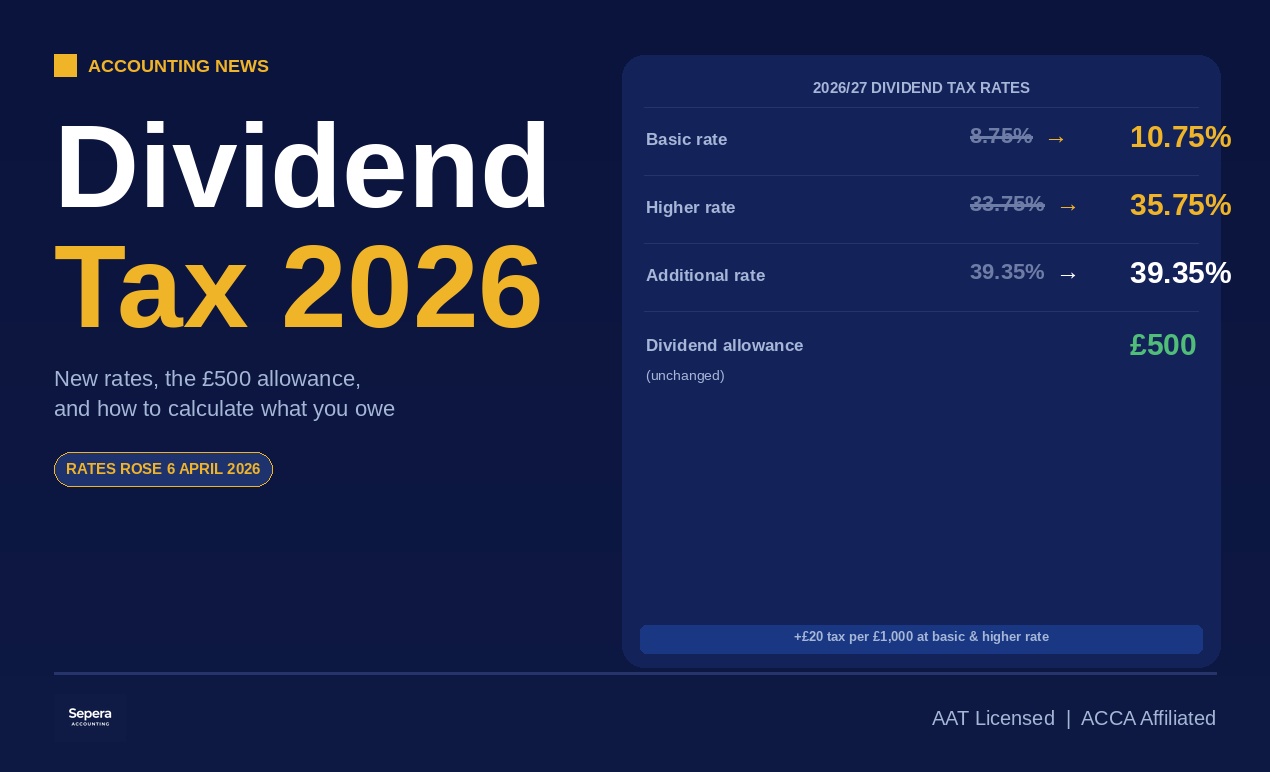
From 6 April 2026, the dividend tax rates increased by two percentage points at the basic and higher rates. The confirmed rates for the 2026/27 tax year are:
- Basic rate: 10.75% (up from 8.75%)
- Higher rate: 35.75% (up from 33.75%)
- Additional rate: 39.35% (unchanged)
Which rate you pay depends on your overall income and which Income Tax band your dividends fall into. The additional rate was left untouched, so the full impact of this increase falls on basic and higher rate taxpayers. In cash terms, the rise adds £20 of tax for every £1,000 of dividends taxed at the basic or higher rate. For a director extracting £50,000 in dividends, the increase alone can mean around £1,000 more tax per year on exactly the same profit.
The Dividend Allowance for 2026/27
Every taxpayer gets a tax-free dividend allowance, which for 2026/27 remains £500, unchanged from the previous year. The first £500 of dividend income each year is taxed at 0%, regardless of your income level.
It is worth understanding a subtle but important point about how the allowance works. It is a nil-rate band, not a deduction. The £500 is taxed at 0%, but it still uses up £500 of whichever tax band your income sits in. It does not give you extra basic-rate room, and it does not reduce your total income for tax purposes. For context, this allowance has been cut dramatically over recent years, from £5,000 in 2017, to £2,000, then £1,000, and now just £500 since 2024/25.
How Dividend Tax Is Calculated
The single most important rule to understand is that dividends are treated as the top slice of your income. Your other income, salary, pension, and rental income, fills up your Personal Allowance and tax bands first. Dividends then sit on top, and the band they land in determines the rate.
This is why the same amount of dividends can be taxed very differently depending on what other income sits beneath it. The size of the dividend alone does not decide the rate; the total income underneath it does. Here is the order in which income is taxed: earnings and pension first, then savings income, then dividends last of all.
Dividend Tax Worked Example: Basic Rate
Suppose you take a £45,000 salary and receive £5,000 in dividends in 2026/27.
Your salary uses £45,000 of your income, leaving £5,270 of basic-rate band remaining before the £50,270 higher-rate threshold. The first £500 of your dividends is covered by the dividend allowance and taxed at 0%. The remaining £4,500 of dividends falls within your remaining basic-rate band and is taxed at 10.75%, giving a dividend tax bill of £483.75. Under the old 8.75% rate, the same dividends would have cost £393.75, so the April 2026 increase adds £90.
Dividend Tax Worked Example: Higher Rate
Now suppose you take a £60,000 salary and receive the same £5,000 in dividends.
Here your salary alone has already pushed you into the higher-rate band, so every pound of dividend stacks on top at the higher rate. The first £500 is still covered by the allowance at 0%, but the remaining £4,500 is taxed at 35.75%, giving a dividend tax bill of £1,608.75. Same dividends, more than three times the tax, purely because of the income sitting underneath them. This is the top-slice rule in action.
Dividend Tax and the Salary vs Dividends Decision
For company directors, dividend tax is only half the picture. The real question is how to split your income between salary and dividends to minimise your combined tax and National Insurance bill. With dividend rates now higher, that balance has shifted, and the optimal split for 2026/27 is not the same as it was two years ago.
This is a decision worth getting right, because it directly affects your take-home pay. Our detailed guide to the salary vs dividends decision walks through the optimal structure, and because dividends come out of post-tax company profit, our guide to Corporation Tax rates explains the tax the company pays before any dividend can be declared.
How to Report and Pay Dividend Tax
How you report dividend tax depends on how much you receive.
- Dividends up to £500: covered by the allowance, no tax due and nothing to report
- Dividends between £501 and £10,000: you must tell HMRC, either by asking them to adjust your tax code or by registering for Self Assessment
- Dividends over £10,000: you must register for Self Assessment and report them on a tax return
If you need to register for Self Assessment for the first time, the deadline is 5 October following the end of the tax year in which you received the dividends. Our Self Assessment guide explains the full process and deadlines. You can also check HMRC’s official guidance on the GOV.UK tax on dividends page.
Legal Ways to Reduce Your Dividend Tax
With rates now at their highest since the current system began, planning matters more than ever. Legitimate ways to manage dividend tax include:
- Use an ISA. Dividends on shares held inside a Stocks and Shares ISA are completely tax-free and do not count towards your allowance at all
- Split shares with a spouse. If your spouse is a lower-rate taxpayer, holding shares jointly can use both dividend allowances and potentially a lower tax band
- Time your dividends. Spreading dividend payments across tax years can keep you within a lower band rather than tipping into the higher rate
- Consider pension contributions. Company pension contributions can be a more tax-efficient way to extract value than dividends in some circumstances, as covered in our guide to limited company pension contributions
- Review your salary vs dividend split. The right balance changes as rates change
How Sepera Accounting Helps With Dividend Tax
Getting dividend tax right is about more than knowing the rate. It means structuring your income across salary, dividends, and pension in the most efficient legal way, timing payments sensibly, and reporting everything correctly to HMRC so you never overpay or face a penalty for getting it wrong.
We are an AAT-licensed, ACCA-affiliated practice with over 30 years of combined experience supporting company directors across London and Stockport. Our limited company accounting service includes dividend and remuneration planning as standard. Get in touch via our contact page or call +44 20 7071 8676 to review your dividend strategy for 2026/27.
Frequently Asked Questions: Dividend Tax
What are the dividend tax rates for 2026/27?
For 2026/27, dividend tax rates are 10.75% at the basic rate, 35.75% at the higher rate, and 39.35% at the additional rate. The basic and higher rates each rose by two percentage points from 6 April 2026, while the additional rate was left unchanged.
What is the dividend allowance for 2026/27?
The dividend allowance for 2026/27 is £500, unchanged from the previous year. The first £500 of dividend income each year is taxed at 0%, though it still uses up £500 of whichever tax band your income sits in.
How is dividend tax calculated?
Dividends are treated as the top slice of your income. Your salary and other income fill your Personal Allowance and tax bands first, then dividends sit on top. The rate you pay depends on which band the dividends fall into once everything else is counted beneath them.
How much dividend can I take before paying tax?
You can receive £500 in dividends tax-free under the dividend allowance. If you have unused Personal Allowance (the £12,570 tax-free amount) not absorbed by other income, dividends can also fall within that, extending the tax-free amount further.
Do I pay National Insurance on dividends?
No. Dividends are not subject to National Insurance, which is one of the reasons a salary-and-dividend split has traditionally been tax-efficient for company directors compared with taking all income as salary.
When do I need to report dividend income to HMRC?
If your dividends are between £501 and £10,000, you must tell HMRC, either by adjusting your tax code or via Self Assessment. If they exceed £10,000, you must register for Self Assessment and report them on a tax return.
Why did dividend tax go up in April 2026?
The basic and higher dividend tax rates rose by two percentage points from 6 April 2026, as announced in the Autumn 2024 Budget. The change is expected to raise an estimated £280 million in additional tax in 2026/27, rising in later years.
Are dividends taxed twice?
In effect, dividend income is taxed at two stages: the company pays Corporation Tax on its profits first, and then the shareholder pays dividend tax personally on the dividends received from those post-tax profits. They are two separate taxes on the same underlying profit.
How can I reduce my dividend tax legally?
Legitimate options include holding shares in an ISA (where dividends are tax-free), splitting shares with a lower-earning spouse, timing dividend payments across tax years, making company pension contributions, and reviewing your salary vs dividend split. An accountant can identify which apply to your situation.
Is it still worth taking dividends instead of salary in 2026/27?
For most company directors, a combination of salary and dividends remains more tax-efficient than salary alone, largely because dividends avoid National Insurance. However, the higher dividend tax rates from April 2026 have narrowed the advantage, making it worth reviewing your optimal split rather than assuming last year’s structure still works best.
This article provides general guidance on dividend tax in the UK for 2026/27. Tax rates and allowances can change. Please contact us for advice tailored to your specific circumstances.