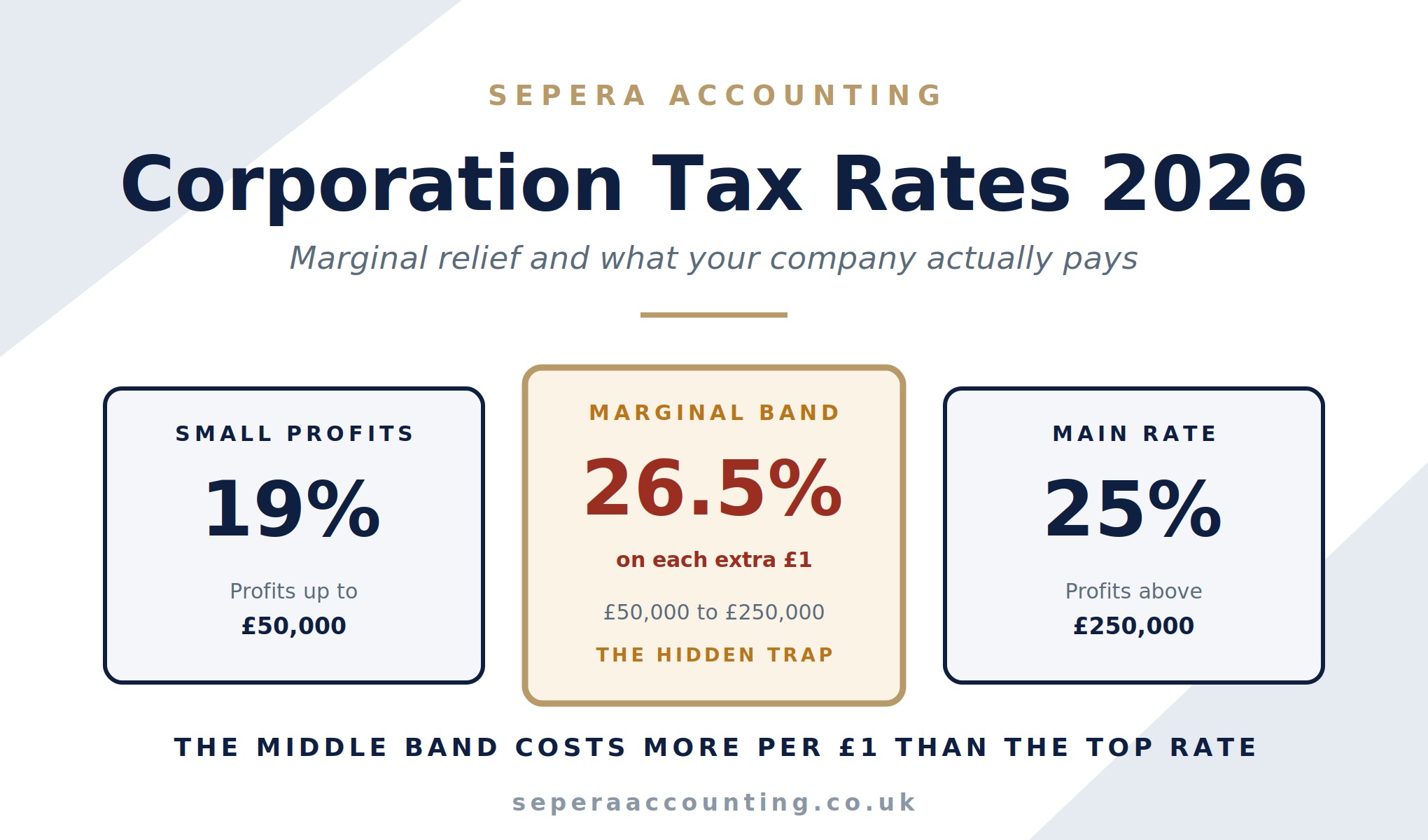
 UK corporation tax rates look simple on paper: 19% for small companies, 25% for big ones. The reality is messier and more expensive. Between £50,000 and £250,000 of profit sits the marginal relief band, where each additional pound of profit is effectively taxed at 26.5%, higher than the headline main rate. Most owner-managed companies live exactly in that band, and most directors have no idea they are paying it.
This corporation tax rates guide sets out the 2026/27 position, how marginal relief actually calculates, the associated companies trap that quietly halves your thresholds, and the planning levers that genuinely move the number.
Corporation tax rates for 2026/27: the headline figures
The corporation tax rates for the 2026/27 financial year are unchanged from the structure introduced in April 2023, and the government has confirmed the main rate is capped at 25% for the duration of this parliament:
- Small profits rate: 19% on taxable profits up to £50,000.
- Main rate: 25% on taxable profits above £250,000.
- Marginal relief band: profits between £50,000 and £250,000 are charged at 25% and then reduced by marginal relief, producing an effective rate that climbs from 19% towards 25% as profits rise.
The thresholds assume a 12-month accounting period and no associated companies. Both assumptions fail more often than directors expect, and when they fail, the thresholds shrink. More on that below.
How marginal relief actually works
Under the current corporation tax rates, companies with profits between £50,000 and £250,000 do not pay a flat rate. The calculation runs in two steps: charge the full 25% on all profits, then subtract marginal relief using HMRC’s formula:
Marginal relief = 3/200 x (£250,000 – taxable profits) (for a standalone company whose augmented profits equal taxable profits).
A worked example. A standalone company with £100,000 taxable profit in 2026/27:
- Tax at 25%: £25,000.
- Marginal relief: 3/200 x (£250,000 – £100,000) = £2,250.
- Corporation tax due: £22,750.
- Effective rate: 22.75%.
Your CT600 software applies the corporation tax rates and relief automatically, so the mechanics are not the problem. The problem is what the formula hides: the marginal rate on each additional pound.
The 26.5% trap inside the marginal band
Here is the counterintuitive part of the current corporation tax rates. Inside the £50,000 to £250,000 band, every extra £1 of profit costs you 25p in tax and strips away another 1.5p of marginal relief. The effective rate on incremental profit in the band is therefore 26.5%, higher than the 25% a company pays above £250,000.
This matters for real decisions:
- Pension contributions made by the company save tax at 26.5% for profits in the band, not 19% or 25%. The band is the most tax-efficient place to make employer pension contributions.
- Timing of expenditure matters more in the band. Bringing forward deductible spending into a year where profits sit between the thresholds buys relief at 26.5%.
- Profit extraction planning changes shape. A bonus that drags company profits below £50,000 can produce a different combined outcome than dividends that leave profits in the band. Our salary vs dividends guide covers the personal side of that equation.
Associated companies: the threshold trap
The £50,000 and £250,000 thresholds are not per company in any group sense. They are divided by the number of associated companies plus one. Two companies under common control means each gets thresholds of £25,000 and £125,000. Three companies means £16,667 and £83,333 each.
Companies are associated where one controls the other, or both are under common control. The rules look through to the shareholders, so a director who owns two trading companies personally has two associated companies, even if the businesses have nothing to do with each other.
The consequences for your corporation tax rates position are direct: a company that would comfortably sit in the 19% small profits band on its own can be pushed into marginal relief, or straight to the 25% main rate, purely because its owner runs a second company. If you operate multiple companies, this single rule can be worth thousands of pounds a year, and it is the first thing we check when a new multi-company client arrives.
Dormant companies are generally ignored for this test, but holding companies and overseas companies can count. The detail matters.
Short accounting periods shrink the thresholds too
The corporation tax rates thresholds also assume a 12-month accounting period, and short periods shrink them proportionally. A 6-month period halves them: £25,000 and £125,000. This catches new companies with short first periods and companies that change their year end. Directors who assume they are in the 19% band because annual profits are under £50,000 can find a time-apportioned threshold pushes part of their profit into the marginal band.
From accounting profit to taxable profit
Corporation tax rates apply to taxable profit, not the profit in your accounts. The adjustments between the two routinely move companies across thresholds:
- Add back disallowable costs: client entertaining, most fines and penalties, and depreciation are not deductible.
- Deduct capital allowances: full expensing (permanent since April 2024) gives a 100% first-year deduction for most new plant and machinery bought by companies. The Annual Investment Allowance covers most other qualifying spend up to £1 million.
- Note the writing-down allowance change: from April 2026, the main pool writing-down allowance falls from 18% to 14%, reducing relief on assets outside full expensing. Timing significant purchases to qualify for full expensing matters more than it did.
- Apply reliefs: R&D relief, losses brought forward and group relief all reduce taxable profit before the corporation tax rates apply.
A company with £60,000 of accounting profit can easily land under £50,000 taxable after capital allowances, changing which of the corporation tax rates applies and dropping its entire liability into the 19% band. Equally, add-backs can push an apparently small company into marginal relief. The rate question is decided after these adjustments, not before.
When corporation tax is due
Whichever of the corporation tax rates applies, for most companies the tax is payable 9 months and 1 day after the end of the accounting period. A 31 March 2026 year end means payment by 1 January 2027. The CT600 return itself is due 12 months after the period end, so the money is due before the return.
Large companies (broadly, taxable profits above £1.5 million, adjusted for associated companies) pay by quarterly instalments instead. HMRC charges interest on late payment from day one, so companies near a threshold should diarise the payment date, not the filing date.
Planning around the corporation tax rates in 2026/27
The current corporation tax rates reward planning in a way the old flat 19% never did. The levers that genuinely work:
- Employer pension contributions for directors, deducted at up to 26.5% in the marginal band.
- Full expensing on plant and machinery, especially with the writing-down allowance falling to 14% from April 2026.
- Timing income and expenditure around the thresholds where you have genuine commercial flexibility.
- Reviewing associated company structures. Sometimes a dormant company should be struck off, or two businesses genuinely belong in one company. Our guide to closing a limited company covers the wind-up options.
- Checking augmented profits. Dividends received from non-group companies count towards the thresholds even though they are not taxed, and can push you into a higher band.
None of these is exotic. All of them are routinely missed by companies filing without advice.
Frequently Asked Questions
What are the corporation tax rates for 2026/27?
The small profits rate is 19% on taxable profits up to £50,000, and the main rate is 25% on profits above £250,000. Profits between the two are charged at 25% reduced by marginal relief, giving an effective rate that rises from 19% towards 25%. The main rate is capped at 25% for the duration of the current parliament.
What is the effective corporation tax rate in the marginal relief band?
Each additional pound of profit between £50,000 and £250,000 is effectively taxed at 26.5%, because it attracts 25% tax and reduces the marginal relief available. Total tax as a percentage of all profits rises gradually from 19% to 25% across the band.
How do associated companies affect corporation tax rates?
The £50,000 and £250,000 thresholds are divided by the number of associated companies plus one. Two companies under common control each get thresholds of £25,000 and £125,000. This applies even where the businesses are completely unrelated, because the test looks at common control.
How is marginal relief calculated?
For a standalone company, marginal relief is 3/200 multiplied by the difference between £250,000 and taxable profits. A company with £100,000 of profit receives £2,250 of relief against a 25% charge of £25,000, paying £22,750 overall. CT600 software performs the calculation automatically.
When do corporation tax rates change next?
No changes to the rates or thresholds have been announced. The government confirmed at Autumn Budget 2024 that the 25% main rate is capped for this parliament and the small profits rate and marginal relief are maintained. The notable 2026 change is elsewhere: the main pool writing-down allowance falls from 18% to 14% from April 2026.
Get your corporation tax rates position reviewed
Corporation tax rates in 2026/27 are a planning question, not just a compliance one. The difference between sitting at £49,000 and £51,000 of taxable profit, or between one company and two associated ones, changes your effective rate and your planning options in ways that compound year after year.
At Sepera Accounting we review exactly where your company sits against the thresholds, model the marginal relief position, check associated company exposure, and time capital spending and pension contributions to get relief at the highest available rate. Get in touch for a review of your position. For the official rates, see gov.uk’s corporation tax rates page.