 Most company directors think closing a limited company UK is the easy bit at the end of running a business. File a form, pay £33, wait two months, done. In reality, the way you wind up the company decides how much tax you pay on the cash left inside it, and getting it wrong in 2026/27 can cost you tens of thousands of pounds.
The three closing a limited company UK routes (strike off, Members Voluntary Liquidation, Creditors Voluntary Liquidation) have completely different tax consequences. With dividend tax hitting 35.75% from April 2026, the BADR rate doubling from 10% to 18% in just two years, and HMRC continuing to tighten the screws on phoenix companies and overdrawn directors’ loan accounts, closing a limited company UK is now a genuine tax planning decision, not just an admin job.
This closing a limited company UK guide explains exactly how each route works in 2026/27, the £25,000 cliff edge that catches most directors out, and how to pick the right option for your company.
The three ways of closing a limited company UK
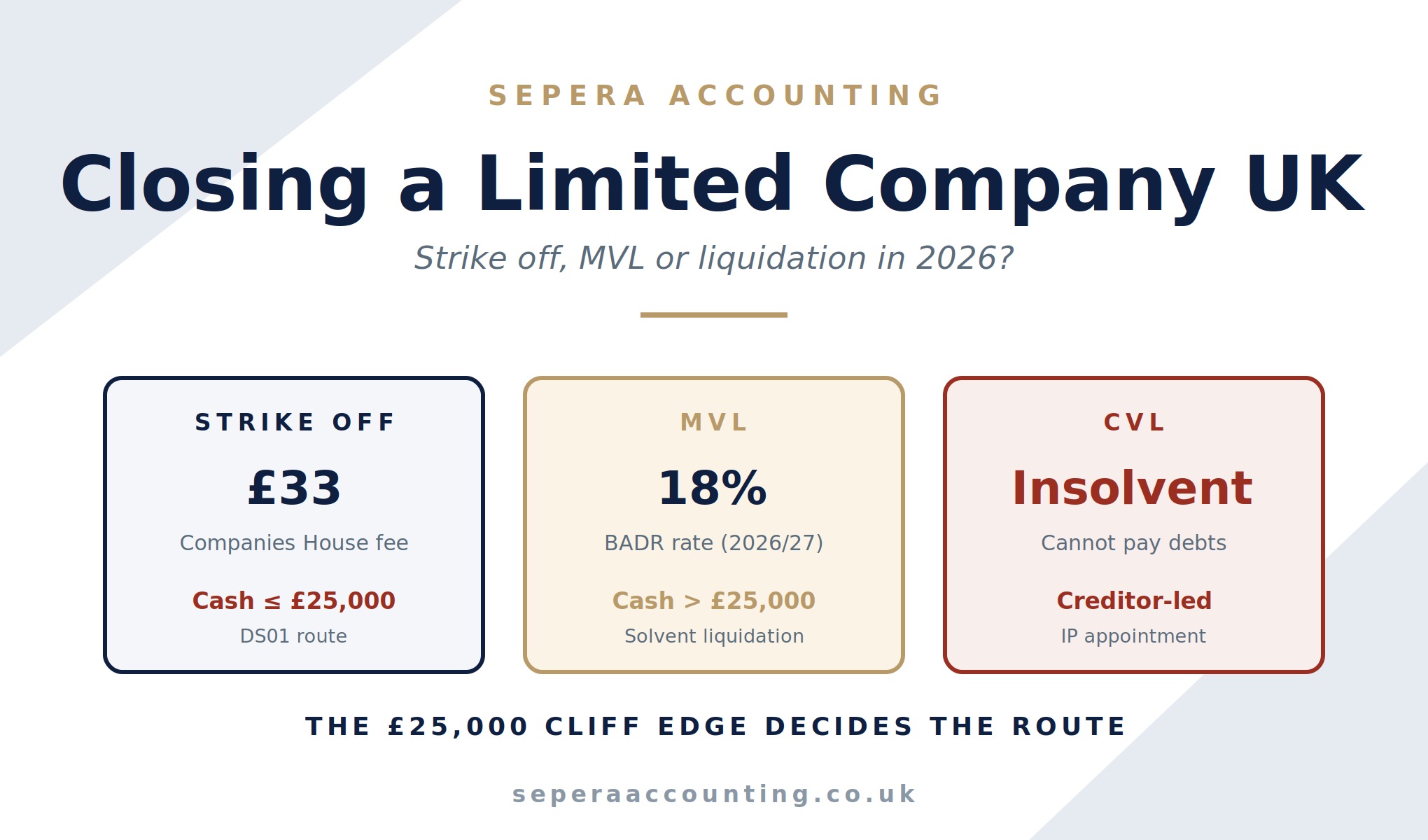
Closing a limited company UK in 2026 means choosing between three formal routes:
- Strike off (voluntary dissolution under DS01): The simplest and cheapest route. Suitable for solvent companies with limited cash to distribute.
- Members Voluntary Liquidation (MVL): A formal solvent liquidation, used when the company has too much cash for strike off but is still solvent.
- Creditors Voluntary Liquidation (CVL): Used when the company cannot pay its debts. An insolvent liquidation route.
The right route for closing a limited company UK depends almost entirely on two things: whether the company is solvent, and how much cash it has left inside. The tax treatment of the remaining cash is fundamentally different under each route, and that is where most of the planning lives.
Strike off (DS01): the simplest route for small solvent companies
Strike off is the default closing a limited company UK option for businesses that have stopped trading and have minimal assets left. You file a DS01 form with Companies House, pay a £33 fee, and (assuming no objections) the company is dissolved roughly two months after the application is gazetted.
The eligibility conditions are strict. To use strike off when closing a limited company UK, the company must:
- Not have traded or carried on business in the last three months.
- Not have changed its name in the last three months.
- Not have sold any business assets, rights or property in the last three months.
- Not be subject to any insolvency proceedings.
- Have settled all outstanding liabilities to HMRC, employees, suppliers and other creditors.
The critical tax point: any distribution to shareholders in anticipation of strike off is treated as capital under CTA 2010 s1030A, but only if the total distributed is £25,000 or less. This is a hard cliff edge. Distribute £25,001 across all shareholders and the entire amount is reclassified as a dividend, taxed at up to 35.75%. There is no proration.
The £25,000 limit is per company, not per shareholder. If a husband-and-wife director couple distribute £30,000 (£15,000 each), the full £30,000 fails the test and is taxed as income, not capital. This catches more directors out than any other single rule when closing a limited company UK.
Members Voluntary Liquidation (MVL): for companies above the £25,000 limit
If your company has more than £25,000 of cash and assets to distribute, strike off becomes the wrong route. A Members Voluntary Liquidation (MVL) is the standard tax-efficient alternative when closing a limited company UK above the £25,000 threshold.
An MVL is a formal liquidation handled by a licensed insolvency practitioner. The directors swear a declaration of solvency, the practitioner is appointed, debts are cleared, and the remaining funds are distributed to shareholders as capital rather than income. That is the whole point of the exercise.
The cost of an MVL typically ranges from £2,000 to £6,000 in liquidator fees for a small company. That sounds expensive until you compare the tax saving. A £100,000 cash balance distributed as a dividend to a higher-rate taxpayer attracts £33,750 of dividend tax (33.75% on the £97,000 above their dividend allowance). The same £100,000 through an MVL, taxed at CGT rates with BADR available, attracts roughly £17,460 (18% on the gain after the £3,000 annual exempt amount). The £16,000+ tax saving comfortably covers the liquidator’s fees.
BADR availability is the key variable. To qualify for the 18% BADR rate (2026/27) on an MVL distribution, you typically need to have owned at least 5% of the shares for at least two years and to have been an officer or employee of the company throughout that period. If you do not qualify for BADR, the MVL distribution is taxed at the standard 24% CGT rate, which is still materially better than 33.75% or 35.75% dividend tax.
Creditors Voluntary Liquidation (CVL): closing an insolvent company
If your company cannot pay its debts as they fall due, strike off and MVL are both off the table. Closing a limited company UK in that position usually means a Creditors Voluntary Liquidation (CVL), which is a formal insolvent liquidation initiated by the directors.
In a CVL, the directors call a shareholders’ meeting, pass a resolution to wind the company up, and appoint a licensed insolvency practitioner. The practitioner takes control of the company’s assets, realises them, pays creditors in statutory order (secured, preferential, unsecured), and reports to creditors throughout the process.
Closing a limited company UK that is insolvent imposes serious personal duties on directors. Continuing to trade after the company becomes insolvent can lead to a wrongful trading claim, with personal liability for losses suffered by creditors after the point insolvency was apparent. Overdrawn directors’ loan accounts at the point of liquidation become recoverable assets of the company that the liquidator will pursue. Taking specialist insolvency advice early, ideally before insolvency crystallises, is essential.
There is also the option of a Company Voluntary Arrangement (CVA) or administration if the underlying business is viable but cash flow is the issue. Closing a limited company UK via CVL is the final step, not the first.
The 2026/27 tax angle: capital vs income on remaining cash
This is where most of the tax planning for closing a limited company UK lives. The same £50,000 sitting in a company at the point of closure can be taxed in radically different ways depending on the route chosen.
Consider a single director with no other income above the higher-rate threshold, £50,000 of cash retained in their company, and £1 of personal allowance unused:
- Strike off route (FAILED): £50,000 distributed is over the £25,000 limit. The full £50,000 is taxed as a dividend. With a £500 dividend allowance, the taxable dividend is £49,500. Tax at 33.75% (higher rate): £16,706. Net retained: £33,294.
- Dividend before strike off: The director pays £25,000 out as a dividend first (taxed at 33.75% = roughly £8,269), then strikes off with the remaining £25,000 distributed as capital (taxed at CGT). Net retained: roughly £37,500. But beware: HMRC may treat the prior dividend as part of the dissolution strategy and refuse the capital treatment.
- MVL route with BADR: Full £50,000 treated as capital. Less £3,000 annual exempt amount. Gain £47,000 taxed at 18% BADR = £8,460. Less liquidator fees of around £3,000. Net retained: roughly £38,540.
- MVL route without BADR: Same calculation but at 24% CGT = £11,280 tax. Less liquidator fees. Net retained: roughly £35,720.
When closing a limited company UK above £25,000, the MVL route is usually the cleanest. Below £25,000, strike off is almost always the answer. Around the threshold, the maths needs running carefully for your specific position. Closing a limited company UK without doing this calculation is leaving money on the table.
One critical complication: if you have an overdrawn director’s loan account at the point of closure, that balance is treated as a distribution. See our directors loan account guide for the full implications. A DLA balance going through closure can trigger both s455 tax inside the company and a personal tax charge for the director.
Closing a limited company UK: step-by-step process
If you have decided strike off is the right route for closing a limited company UK, the typical process runs as follows:
- Cease trading. Stop all business activity. No invoices issued, no contracts signed, no payroll runs after the cessation date.
- Settle all liabilities. Pay outstanding suppliers, HMRC (Corporation Tax, VAT, PAYE), and employees. Deregister for VAT and PAYE.
- File final accounts and tax returns. Submit final statutory accounts and a Company Tax Return covering the period to cessation.
- Distribute remaining assets. Pay out the remaining cash to shareholders, keeping the total under £25,000 if capital treatment is intended.
- Close the bank account. Any cash left in the company’s bank account when struck off becomes bona vacantia (property of the Crown). You cannot get it back later.
- Wait three months. The three-month no-trading rule starts from the cessation date.
- File DS01. Submit the strike-off application to Companies House with the £33 fee, and notify all creditors, shareholders, employees and pension trustees within seven days.
- Respond to objections. HMRC or any creditor can object. If they do, the strike off pauses until the objection is resolved.
- Strike off completed. Approximately two months after the gazette notice, the company is dissolved.
For an MVL, the process is broadly similar in the early stages, but step 4 is replaced by appointing a licensed insolvency practitioner who handles the formal liquidation.
Common mistakes when closing a limited company UK
Closing a limited company UK looks straightforward on paper. The mistakes that catch directors out cluster around a few specific points:
- Forgetting the £25,000 cliff edge. Strike off distributions of £25,001 are taxed as income on the full amount. There is no soft landing.
- Paying a dividend immediately before strike off. HMRC may treat the dividend as part of the dissolution strategy and deny capital treatment on the remaining balance.
- Leaving cash in the bank account. Money still in the company at strike off goes to the Crown as bona vacantia. Recovering it requires a court restoration that costs more than the cash usually justifies.
- Ignoring an overdrawn DLA. An overdrawn directors’ loan account at closure is treated as income to the director and may also still attract s455 tax at 35.75% inside the company.
- Missing the two-year rule. If the company is not actually dissolved within two years of the distribution, capital treatment is withdrawn and the distribution is reclassified as income, retrospectively.
- Selling assets just before applying for strike off. Disposing of business assets within three months of the DS01 application disqualifies the strike off.
- Closing a limited company UK without taking advice on phoenix rules. If you set up a similar business within two years of dissolution, the targeted anti-avoidance rules (TAAR) can recharacterise an MVL capital distribution as income.
Frequently Asked Questions
How much does closing a limited company UK cost in 2026?
A simple strike off via DS01 costs £33 at Companies House. A Members Voluntary Liquidation typically costs £2,000 to £6,000 in liquidator fees depending on company size and complexity. A Creditors Voluntary Liquidation is usually paid from company assets but can cost more for complex insolvencies.
What is the £25,000 limit when closing a limited company UK?
Under CTA 2010 s1030A, distributions made to shareholders in anticipation of strike off can be treated as capital (taxed at CGT rates) only if the total distributed is £25,000 or less. Exceeding £25,000 by even £1 means the entire amount is taxed as a dividend. The limit is per company, not per shareholder.
Can I just stop trading and let HMRC strike the company off?
Companies House will eventually strike off a company that fails to file accounts or confirmation statements, but this is not a tax-efficient way of closing a limited company UK. Any cash left inside is lost to bona vacantia, you may face penalties for late filing, and the directors lose control of the timing and tax treatment.
What happens to corporation tax when closing a limited company UK?
The company must file a final Company Tax Return covering the period from the last accounting period to the date of cessation. Any Corporation Tax due must be paid in full before strike off. HMRC will object to the strike off application if tax is outstanding.
Is BADR still available in 2026/27 when closing a limited company UK?
Yes, but at 18%, up from 14% in 2025/26 and 10% before April 2025. The lifetime limit remains £1m. Standard qualifying conditions apply: 5% shareholding, two-year ownership period, and officer or employee status throughout.
Closing a limited company UK: get the right advice before you start
Closing a limited company UK is a one-shot decision. Once the route is chosen and the distributions are made, you cannot rewind and choose differently. The tax consequences are locked in by the route you take and the timing of the distributions, and they can vary by tens of thousands of pounds on the same cash balance.
At Sepera Accounting we help limited company directors plan and execute the closure of their companies in the most tax-efficient way. We model the strike off vs MVL decision, handle the final accounts and tax returns, coordinate with licensed insolvency practitioners where MVL is the right route, and make sure the £25,000 cliff edge, overdrawn DLAs and phoenix rules do not cost you. Get in touch for a clear walkthrough of your options. For official HMRC guidance on the formalities, see gov.uk’s strike-off guide.