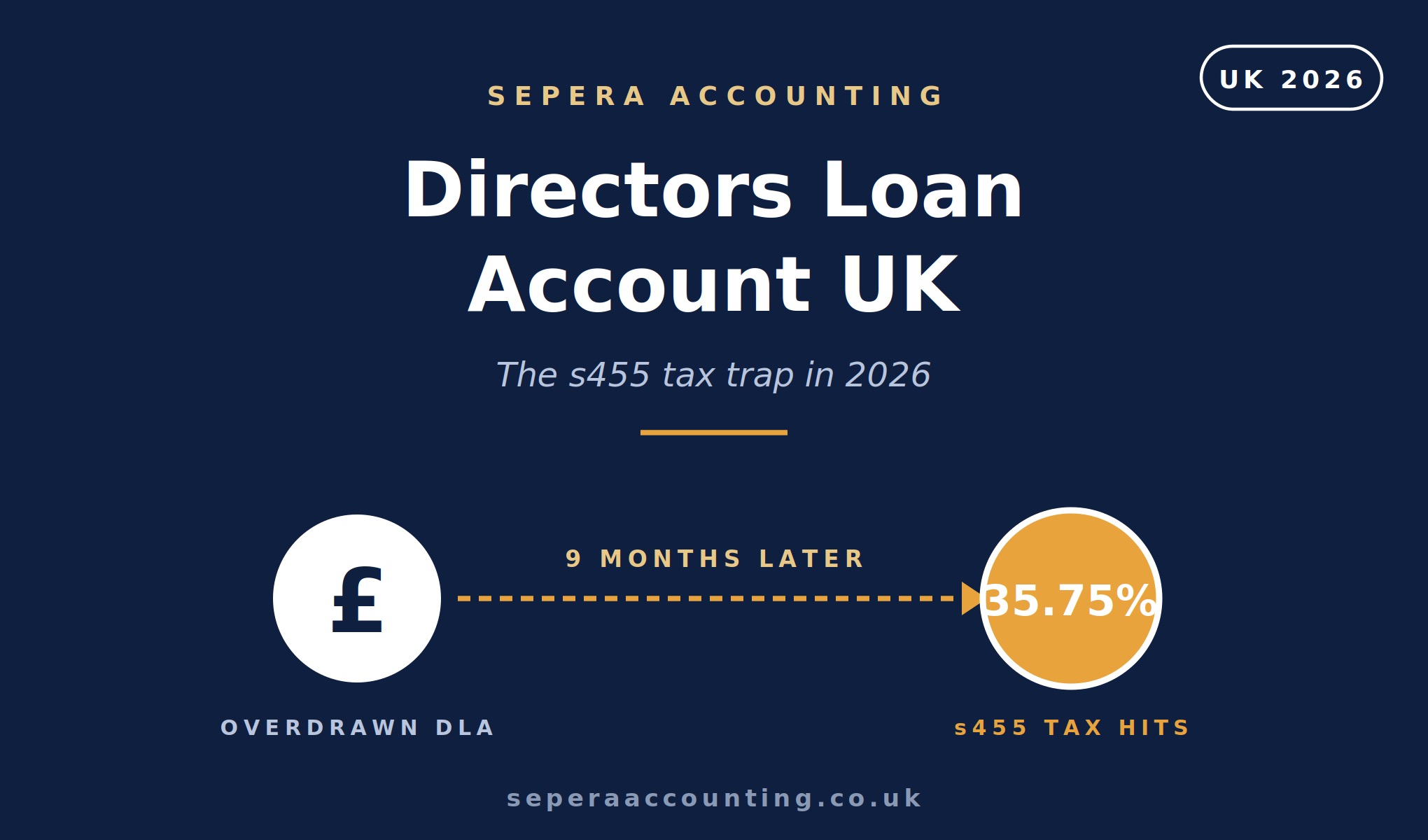
 If you take money out of your limited company that is not salary, dividend or reimbursed expense, you have created a directors loan account UK entry. It is one of the most common things owner-managed companies do. It is also one of the most expensive things to get wrong in 2026.
The rules just got tougher. From 6 April 2026, the s455 tax rate on overdrawn balances jumped from 33.75% to 35.75% following the 2025 Budget. HMRC’s Official Rate of Interest also climbed to 3.75%, the highest in years. Most online guides on directors loan account UK rules still quote last year’s figures, which is why so many directors are heading into year-end with the wrong numbers in their head.
This guide explains exactly how a directors loan account UK works in the current 2026/27 tax year, what the new s455 rate means in cash terms, the Benefit-in-Kind trap on loans over £10,000, and how to clear an overdrawn balance without handing HMRC more than you have to.
What is a directors loan account UK?
A directors loan account UK, sometimes called a DLA, is the ledger in your company’s accounts that tracks every transaction between you (as a director) and the company that is not a salary, dividend or genuine expense reimbursement.
It runs in both directions. Money you put into the company (lending it cash, paying a supplier from personal funds) reduces the balance you owe. Money you take out (cash transfers to your personal account, personal expenses paid by the company, company cards used personally) increases what you owe. At any given moment, your directors loan account UK is either in credit (the company owes you) or overdrawn (you owe the company).
Credit balances are not a tax problem. Overdrawn balances are where the trouble starts.
How a directors loan account UK works in practice
Most small company directors create a directors loan account UK without ever realising it. Common ways the balance creeps up:
- Paying a personal credit card bill with the company debit card.
- Transferring cash to your personal account when your dividend hasn’t been formally declared.
- Buying something personal on Amazon using the company card by mistake.
- Drawing money to cover personal expenses with a vague plan to repay later.
- Taking advances against future dividends or bonuses.
Each of these adds to the overdrawn balance on your directors loan account UK. The company’s accountant records them, and at the end of the financial year, the cumulative balance is what HMRC cares about.
HMRC’s view is straightforward. A loan from your company is a loan, and if it sits there too long, they tax it.
The s455 tax charge: the directors loan account UK trap
This is where most directors get caught. If your directors loan account UK is overdrawn at the end of the company’s accounting period, and the balance is still outstanding nine months and one day later, the company must pay s455 tax on the outstanding amount.
For loans made on or after 6 April 2026, the s455 rate is 35.75%, up from 33.75% previously. The rate now mirrors the new higher rate of dividend tax following the 2025 Budget. Loans made before 6 April 2026 are still charged at 33.75%.
The mechanics:
- The company pays the s455 charge, not the director personally.
- It is paid alongside the company’s Corporation Tax, nine months and one day after the year-end.
- It is refundable once the loan is repaid, written off, or covered by a dividend or salary.
- However, the refund cannot be claimed until nine months after the end of the accounting period in which repayment occurred. So expect cash to be tied up for well over a year.
This is the biggest cash flow trap on any directors loan account UK. A £20,000 overdrawn balance at the new rate produces a £7,150 charge. That money sits with HMRC for the best part of two years before you see it again, even when you have done nothing legally wrong.
Benefit-in-Kind: the second tax layer
The s455 charge sits at the company level. There is also a personal tax exposure on most directors loan account UK balances above £10,000 at any point in the tax year.
If your DLA exceeds £10,000 and the company does not charge you interest at or above HMRC’s Official Rate of Interest, the difference is treated as a taxable Benefit-in-Kind. For 2026/27 the Official Rate is 3.75%, up sharply from 2.25% in 2025/26.
The cash impact:
- The director pays Income Tax on the notional interest at their marginal rate (20%, 40% or 45%).
- The company pays Class 1A National Insurance on the same figure at 15%.
- The benefit must be reported on a P11D.
So a £30,000 directors loan account UK balance for a full year with no interest charged creates £1,125 of notional interest. A higher rate taxpayer pays £450 of personal Income Tax on that, and the company pays £169 of Class 1A NIC. Small individually, but easily missed and a classic HMRC enquiry trigger.
Bed and breakfasting: HMRC’s anti-avoidance rule
Directors used to “clear” their directors loan account UK on the last day of the accounting period and re-borrow the same money days later, dodging s455 entirely. HMRC closed that door years ago.
The anti-avoidance rule (sometimes called the 30-day rule) catches any repayment of £5,000 or more that is followed by a new advance within 30 days. HMRC ignores the repayment for s455 purposes. There is also a wider “intentions” test that catches longer-cycle versions of the same trick.
In plain English: you cannot use temporary repayments to game the system. The repayment has to be genuine and permanent.
How to clear a directors loan account UK and reclaim s455
There are four ways to clear an overdrawn directors loan account UK and stop the s455 clock. Each has different tax consequences.
1. Cash repayment. The cleanest option. You repay the company from your own personal funds. No personal tax cost, no Corporation Tax knock-on, just settlement of the debt. The company can then claim back any s455 paid.
2. Dividend declaration. If the company has distributable reserves, declaring a dividend and crediting it to your directors loan account UK clears the loan. You pay personal dividend tax (8.75%, 33.75% or 35.75% from 6 April 2026 depending on your band), but no s455 if done within the nine-month window.
3. Salary or bonus. Less common because it triggers PAYE and Employee + Employer NIC, which is usually more expensive than dividends. Sometimes useful where the director has unused personal allowance or the company’s reserves are insufficient for dividends.
4. Write-off. The company formally releases the loan. The directors loan account UK is cleared, but the written-off amount is treated as a distribution to the director and taxed at dividend rates. The company cannot claim Corporation Tax relief on the write-off.
To reclaim s455 once a loan is permanently repaid, the company uses the CT600A or the L2P form on gov.uk. The earliest claim date is nine months and one day after the end of the accounting period in which repayment happened.
Worked example: a £20,000 overdrawn directors loan account UK in 2026/27
Let’s put the numbers together. Imagine a company with a 31 March 2026 year-end. The director’s directors loan account UK is overdrawn by £20,000 throughout the year. No interest is charged.
By 1 January 2027, the balance is still outstanding. The clock has run out.
- s455 charge: £20,000 x 35.75% = £7,150 payable by the company alongside its Corporation Tax.
- Benefit-in-Kind: £20,000 x 3.75% = £750 notional interest. For a higher rate taxpayer, that is £300 of personal Income Tax. The company also pays £113 of Class 1A NIC at 15%.
- Total tax cost in year one: £7,563 (£7,150 company s455 + £300 personal income tax + £113 company NIC).
Now imagine the director declares a £20,000 dividend on 30 June 2027 to clear the balance.
- Personal dividend tax: at 35.75% higher rate = £7,150 (less the £500 allowance).
- s455 reclaim: the £7,150 paid earlier becomes refundable, but the claim cannot be made until 1 January 2028 (nine months after the end of the 31 March 2027 period).
The company recovers the s455. The director pays the dividend tax. The net effect is that money you used personally gets taxed roughly the same as if you had taken it as a dividend in the first place. The directors loan account UK route only saves tax if you genuinely repay from other sources.
How to avoid s455 on your directors loan account UK
Most s455 charges are entirely avoidable with planning. Practical steps:
- Monitor the balance monthly. Do not wait until year-end to discover where you stand on your directors loan account UK.
- Plan dividends in advance. If the company has reserves and you anticipate the balance going overdrawn, plan formal dividend declarations through the year rather than scrambling at the deadline.
- Charge interest at the Official Rate. If you do need to keep a balance above £10,000, charge interest at 3.75% and pay it during the year. That removes the BIK exposure (though not the s455 if the loan remains outstanding past nine months).
- Document everything. Board minutes for dividends, signed loan agreements where relevant, and clean accounting records. HMRC inspects directors loan account UK records far more often than people expect.
- Use professional support. A good limited company accountant will flag DLA risks well before they become tax bills.
For more on tax-efficient ways to take money out of a limited company, see our guide on salary vs dividends UK in 2026. HMRC’s own published guidance is at the gov.uk directors loans page.
Frequently Asked Questions
What is the s455 tax rate for 2026/27?
The directors loan account UK s455 tax rate is 35.75% for loans made on or after 6 April 2026, up from 33.75% previously. The change mirrors the new higher rate of dividend tax following the 2025 Budget.
How long can a directors loan account UK stay overdrawn?
You have nine months and one day after your company’s accounting year-end to clear the balance. Past that point, s455 tax becomes payable on whatever remains outstanding.
Do I pay personal tax on a directors loan?
Not on the loan itself, but if your directors loan account UK exceeds £10,000 at any point in the tax year and you are not paying interest at HMRC’s Official Rate of 3.75%, a Benefit-in-Kind charge applies. That is taxed personally on the notional interest, and the company pays Class 1A NIC.
Can I clear my directors loan account UK with a dividend?
Yes, if the company has distributable reserves. Declaring a dividend and crediting it to your DLA is a common and lawful way to clear the balance. You pay personal dividend tax, but you avoid the s455 charge if it is done within the nine-month window.
What happens if my company writes off my loan?
The written-off amount is treated as a distribution to you, taxed as a dividend on your Self Assessment. The company cannot claim Corporation Tax relief on the write-off, but it can reclaim any s455 already paid.
Directors loan account UK: get expert advice from Sepera Accounting
A directors loan account UK can be a useful, flexible tool. It can also be one of the most expensive corners of the tax code for owner-managed companies that don’t watch it carefully. With the s455 rate now at 35.75% and the Official Rate at 3.75%, the cost of inattention has gone up sharply in 2026.
At Sepera Accounting, we monitor directors loan account UK balances for our limited company clients throughout the year, not just at year-end. Get in touch today and we will review where you stand, model the options, and help you avoid the s455 cash flow trap before it bites.