 Payments on account generate more confused phone calls to accountants than any other part of Self Assessment, and July is when the phones ring. The second instalment for 2025/26 is due by midnight on 31 July 2026, six months after the January payment most people remember and budget for. The July one feels different: it arrives mid-summer, it is tax on a year you have not even filed a return for yet, and to most self-employed people it looks suspiciously like being taxed twice.
You are not being taxed twice. This guide explains what payments on account actually are, who has to make them, how the amounts are calculated, the first-year shock that catches every newly self-employed person, when you can legitimately reduce them, and what actually happens if you pay late (which is not what most articles claim).
What payments on account are
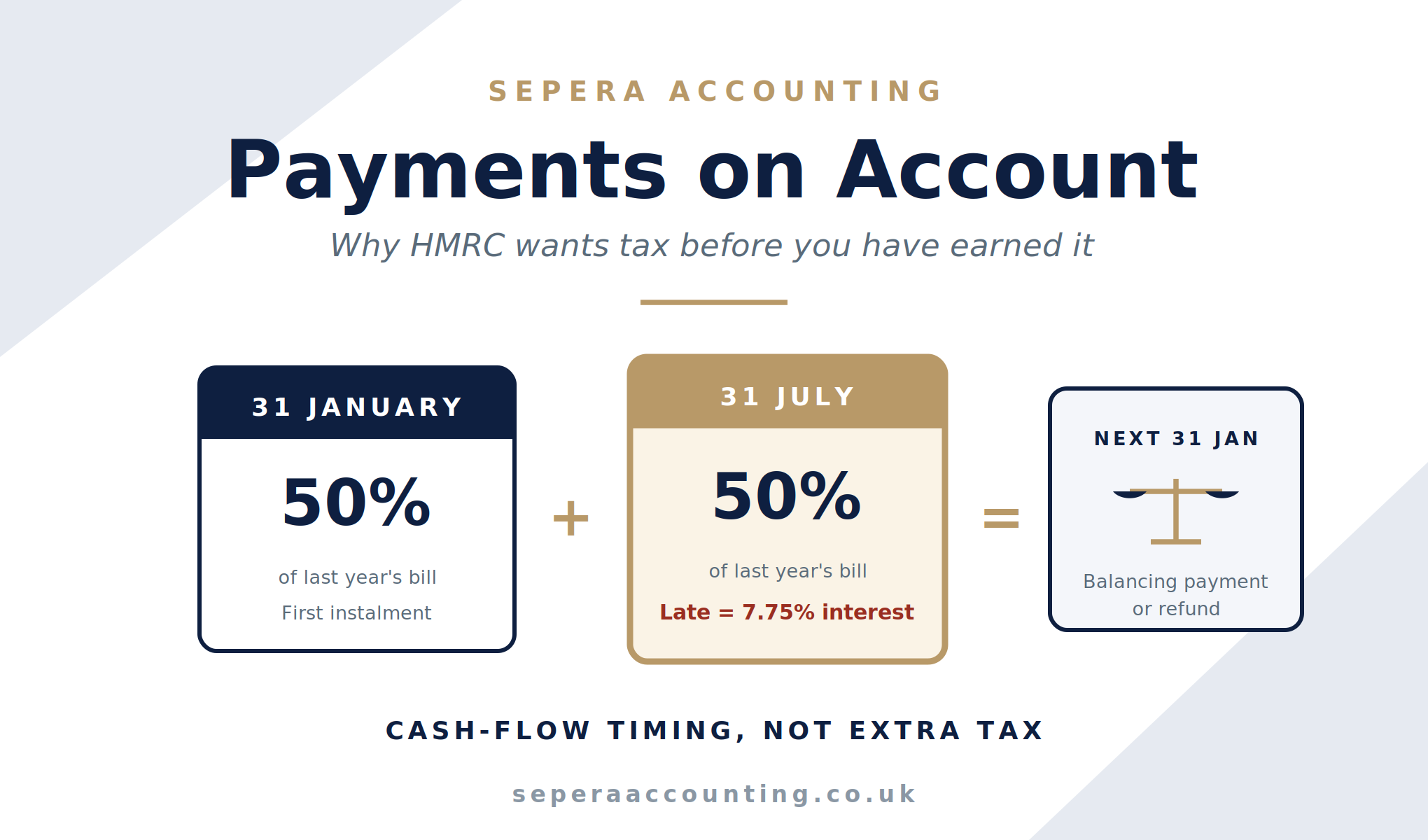
Payments on account are advance instalments towards your next Self Assessment bill. Instead of collecting a full year of tax in one January lump, HMRC collects it in two halves during the year:
- First payment on account: 31 January, during the tax year itself.
- Second payment on account: 31 July, shortly after the tax year ends.
- Balancing payment: the following 31 January, once your actual return shows the true figure, topping up or triggering a refund.
Each instalment is 50% of your previous year’s income tax and Class 4 National Insurance bill. The logic is simple and blunt: HMRC assumes this year will look like last year. No account is taken of a lost client, a quiet spring, or a career break. The system corrects itself only when the actual return is filed.
Two things the instalments never include: Capital Gains Tax and student loan repayments. Those are settled in full with the balancing payment.
Who has to make payments on account
You must make payments on account if both of the following applied to your last Self Assessment bill:
- It was more than £1,000, and
- Less than 80% of your tax was collected at source (through PAYE, for example).
That threshold catches most sole traders, freelancers, landlords with meaningful rental profits, and company directors whose income is mostly dividends. It excludes employees with small side income, because their PAYE typically covers more than 80% of the total. If your only Self Assessment liability is a small top-up, payments on account never trouble you.
A worked example
Suppose your 2024/25 Self Assessment bill was £6,000 of income tax and Class 4 NIC:
- 31 January 2026: £3,000 first payment on account for 2025/26 (paid alongside any 2024/25 balancing payment).
- 31 July 2026: £3,000 second payment on account for 2025/26.
- 31 January 2027: the truth-up. If your actual 2025/26 bill is £7,000, you pay a £1,000 balancing payment (plus the first instalment for 2026/27). If it is £5,000, HMRC refunds £1,000 or sets it against the next instalment.
Seen over the full cycle, payments on account are cash-flow timing, not extra tax. You only ever pay what the return finally shows. The pain is entirely in when the money leaves, not how much.
The first-year shock: 18 months of tax in one day
The brutal moment in the system is the first January after your bill crosses the £1,000 threshold. That day you pay the entire balancing amount for the year just finished, plus the first 50% instalment for the year ahead. On a £6,000 bill, January demands £9,000: the £6,000 you expected and £3,000 you probably did not.
Nobody warns the newly self-employed about this, and it arrives exactly when a growing business has spent its cash on growing. The defence is knowing it is coming: from your first month of self-employment, setting aside 25 to 30% of profits into a separate tax account absorbs the first-year double hit without drama. If you are in your first year now, start today; your January self will be grateful.
Reducing payments on account when income falls
Because the instalments are based on last year, they overcharge you whenever this year is genuinely worse. HMRC allows you to claim a reduction, online through your tax account or on form SA303, if you reasonably expect the current year’s bill to be lower. Legitimate reasons include falling trading income, a move into PAYE employment, incorporation of your business, maternity or other leave, or larger pension contributions.
The discipline matters more than the entitlement:
- Base the claim on evidence, not optimism: management figures, year-to-date income, a realistic forecast.
- Over-reduce and interest bites. If you cut your payments on account below what the final return shows they should have been, HMRC charges late payment interest on the shortfall, backdated to the original due dates, currently at 7.75%.
- Reducing to nil because cash is tight is not a reduction claim, it is a deferral with an interest bill attached. If the problem is cash rather than income, a Time to Pay arrangement with HMRC is the honest and usually cheaper route.
What actually happens if you pay late
Here is the detail most July articles get wrong. Late payments on account attract interest, but not the 5% late payment penalties. The penalty surcharges (5% at 30 days, 6 months and 12 months) apply to the balancing payment, not to the instalments themselves. What you face on a late instalment is daily interest at HMRC’s late payment rate, which is the Bank of England base rate plus 4%: 7.75% from 9 January 2026.
That is not an invitation to treat 31 July as optional. Interest at 7.75% is more expensive than most business borrowing, it runs from 1 August with no grace period, and a pattern of late payment invites HMRC attention nobody wants. But it does mean a few days of unavoidable slippage costs pounds rather than hundreds, and that panic-borrowing at a worse rate than 7.75% to pay a day early is bad maths.
If you genuinely cannot pay, contact HMRC before the deadline about a Time to Pay arrangement. Spreading the debt over months is routinely agreed for taxpayers who engage early, and it stops the situation compounding.
Payments on account for company directors
Directors on a low-salary, dividend-based structure meet the system through their dividend tax. Because dividends carry no tax at source, a director with a meaningful dividend income almost always breaches both tests: the bill exceeds £1,000 and far less than 80% is collected at source. The instalments then swing with your dividend decisions: a big dividend year inflates next year’s payments on account even if you plan a quieter year, which is exactly when a reduction claim is worth considering. How you set the salary and dividend mix in the first place is covered in our salary vs dividends guide.
Does Making Tax Digital change any of this?
Not yet. Making Tax Digital for Income Tax began in April 2026 for the self-employed and landlords with qualifying income over £50,000, and it changes how you report (quarterly digital updates), not when you pay. The January and July payments on account dates continue unchanged. Whether payment timing eventually moves closer to real time is a live policy discussion, but for 2026 the calendar stands.
Frequently Asked Questions
Why am I paying tax on income I have not earned yet?
Payments on account are advances towards the current year’s bill, estimated at last year’s level. Over the full cycle you only ever pay what your actual return shows; the instalments simply move the timing forward. The balancing payment or refund corrects any difference once you file.
When are payments on account due?
31 January and 31 July each year, each instalment being half of your previous year’s income tax and Class 4 NIC bill. The second payment on account for 2025/26 is due by midnight on 31 July 2026. Any balancing payment follows on the next 31 January.
Can I reduce my payments on account?
Yes, online or via form SA303, if you reasonably expect this year’s bill to be lower than last year’s. Base the claim on evidence, because if you reduce below the correct amount HMRC charges interest on the shortfall backdated to the original due dates.
What happens if I miss the 31 July deadline?
Interest runs daily from 1 August at HMRC’s late payment rate, currently 7.75%. The 5% late payment penalties do not apply to payments on account themselves, only to a late balancing payment. If you cannot pay, arrange Time to Pay with HMRC before the deadline.
Do payments on account include Capital Gains Tax?
No. Payments on account cover income tax and Class 4 National Insurance only. Capital Gains Tax and student loan repayments are paid in full with the balancing payment on 31 January.
Make July boring again
Payments on account are not extra tax, but they are unforgiving of surprise. The whole system rewards exactly two habits: setting tax money aside monthly from the start of self-employment, and reviewing the instalments against real year-to-date figures before each deadline rather than after it.
At Sepera Accounting we calculate whether a reduction claim is justified, evidence it properly, set up Time to Pay where cash is the issue, and plan dividend timing so the instalments stop ambushing you. Get in touch before the deadline, not after. For the official guidance, see gov.uk’s payments on account page.