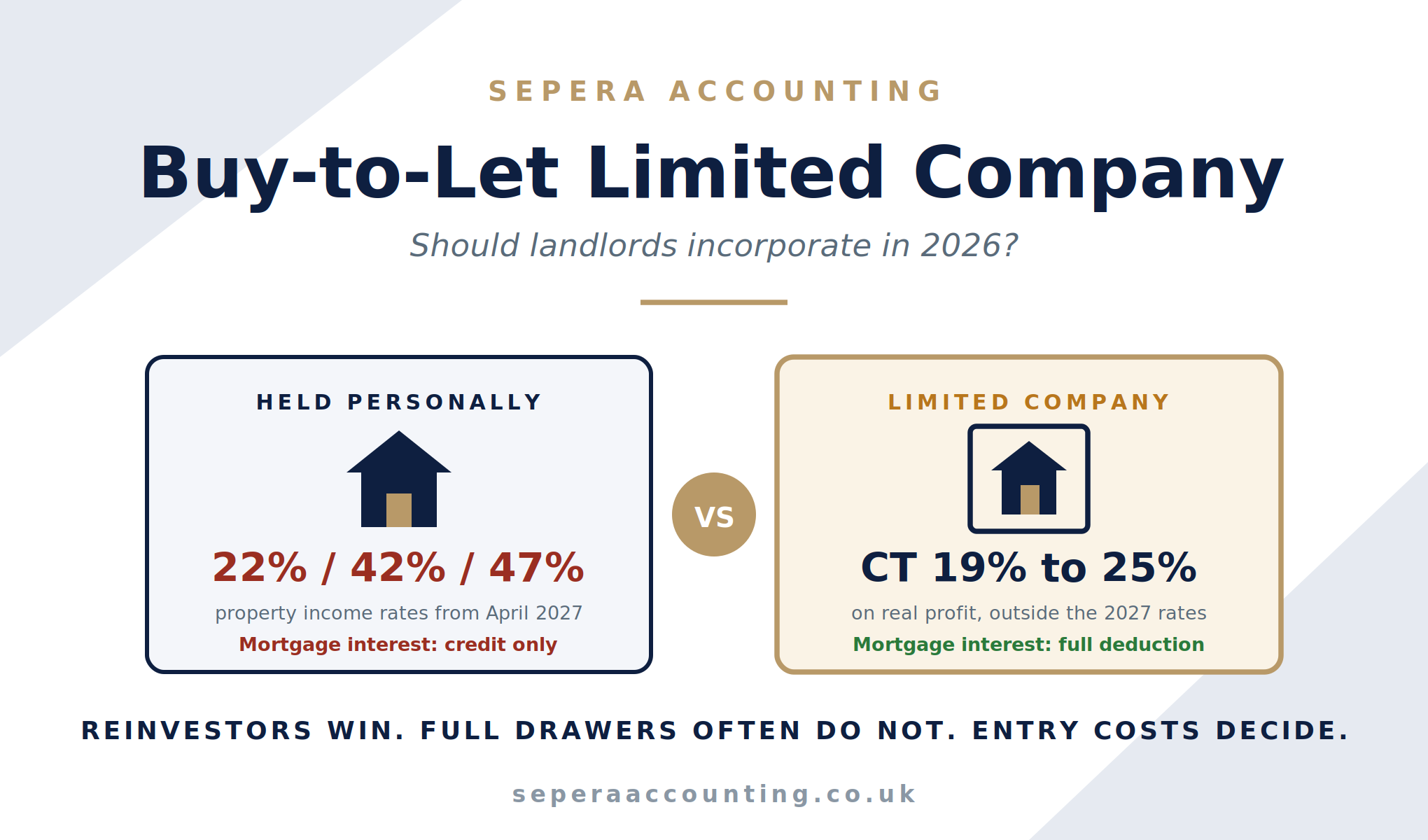
 The buy-to-let limited company question has been asked at every landlord dinner table since mortgage interest relief was restricted, but the Autumn 2025 Budget changed the arithmetic underneath it. From April 2027, rental profits held personally will be taxed at new, separate property income rates of 22%, 42% and 47%, two percentage points above ordinary income tax at every band. Meanwhile a company holding the same properties pays corporation tax and deducts every pound of mortgage interest in full.
That gap is why incorporation enquiries have surged, and why half the advice online is dangerously incomplete. This guide covers what a buy-to-let limited company genuinely changes, the extraction layer that eats part of the saving, the entry costs that can sink the case for existing portfolios, and who the structure actually suits in 2026.
Why the question is suddenly urgent again
Three settled facts frame every buy-to-let limited company decision in 2026:
- Personal property income rates rise from April 2027. Announced at the Autumn Budget 2025 and legislated in the Finance Act 2026, rental profits will be taxed at 22% (basic), 42% (higher) and 47% (additional), separate from and above the ordinary income tax bands. The government’s stated logic: landlords pay no National Insurance on rents, so property income should carry more tax.
- Section 24 still bites. Individual landlords cannot deduct mortgage interest from rental profits; they receive only a basic-rate tax credit instead (recalculated at the new 22% property basic rate from April 2027). Higher-rate taxpayers with meaningful gearing are taxed on profits they never actually receive.
- Companies are outside both rules. A buy-to-let limited company deducts finance costs in full and pays corporation tax at 19% to 25% on the true profit. The new 2027 property rates apply to individuals, not companies.
For a higher-rate landlord with substantial mortgages, that combination is the whole argument: taxed at 42% on phantom profit personally, versus corporation tax on real profit in a company.
What a buy-to-let limited company actually changes
- Full mortgage interest deduction. The single biggest buy-to-let limited company advantage. Finance costs reduce taxable profit pound for pound, exactly as they did for individuals before 2017.
- Corporation tax instead of income tax. 19% on profits up to £50,000, 25% above £250,000, with marginal relief between. For most single-property and small-portfolio companies, profits sit in or near the 19% band.
- Retained profits compound faster. Profit kept inside the buy-to-let limited company for the next deposit has suffered only corporation tax, not 42% or 47%. This is the engine of the incorporated portfolio-builder strategy.
- Shareholding flexibility. Shares can be split with a spouse, moved gradually to children, and structured for inheritance planning in ways bricks held personally cannot.
- A quiet compliance bonus. Making Tax Digital for Income Tax now applies to individual landlords in phases from April 2026, but companies are outside it, and HMRC has confirmed MTD for Corporation Tax has been shelved. A buy-to-let limited company files accounts and a CT600 annually, with no quarterly MTD updates.
The extraction catch: the second layer of tax
Corporation tax is not the end of the buy-to-let limited company story if you spend the rent. Money leaving a buy-to-let limited company as dividends is taxed again personally, and dividend rates rose in April 2026 to 10.75% at basic rate and 35.75% at higher rate. A higher-rate landlord who needs every pound of rental profit to live on can find the combined company-plus-dividend take approaches, and in some profiles exceeds, what they would have paid personally.
This is the sorting mechanism of the whole buy-to-let limited company decision:
- Reinvestors win. If profits stay in the company funding the next purchase, only corporation tax has been paid, and the 2027 personal rates become irrelevant to you.
- Full drawers often do not. If every pound comes out as dividends immediately, the double layer erodes most of the advantage, and for basic-rate, low-geared landlords it can produce a worse result than staying personal.
- Partial drawers need modelling. Most real landlords sit between the extremes, and the answer turns on gearing, band, and how much the household actually needs from the rents. The mechanics of extracting efficiently are the same salary-and-dividend questions we cover in our salary vs dividends guide.
Existing portfolio? The entry costs are the real decision
Here is where most online enthusiasm for the buy-to-let limited company quietly collapses. Transferring properties you already own into a company is legally a sale at market value, and the way in is expensive:
- Capital Gains Tax now. The transfer into a buy-to-let limited company crystallises every accrued gain, taxed at 18% or 24% on residential property, with only a £3,000 annual exempt amount, reportable and payable within 60 days of completion. A portfolio bought a decade ago can carry six-figure gains.
- SDLT on the way in. The company pays Stamp Duty Land Tax on the market value, including the 5% additional dwellings surcharge that has applied since October 2024. On a £300,000 property that is a five-figure entry ticket per property.
- Refinancing. Personal buy-to-let mortgages cannot simply move across. The company needs its own lending, typically at higher rates and with fresh fees, and lender consent shapes the timetable.
- Incorporation relief exists, but the bar is high. Section 162 relief can defer the CGT where a genuine property business (not passive investment) is transferred wholly in exchange for shares. Case law requires real, substantial activity, and the largest claims attract HMRC attention. It is a relief to be evidenced and advised on, never assumed. Partnership structures marketed as SDLT workarounds deserve particular scepticism.
The blunt summary: for existing portfolios, the buy-to-let limited company is a capital project with a payback period, not a free tax switch. Sometimes the payback is compelling, especially for heavily geared higher-rate landlords planning to hold long term. Sometimes the entry costs exceed a decade of annual savings.
Buying new? The case is far cleaner
None of those entry costs applies to a property the buy-to-let limited company buys directly. Purchasing the next property through a buy-to-let limited company involves the same SDLT any additional dwelling attracts, no CGT event, and lending arranged as company lending from day one. This is why the most common sensible structure in 2026 is hybrid: existing properties stay personal (at least until sold), and new acquisitions go into the company. The 2027 rate rise strengthens that pattern further, because it penalises the personal side of the ledger every year from here.
Who a buy-to-let limited company suits in 2026
The buy-to-let limited company typically works for: higher and additional-rate taxpayers; landlords with significant mortgage gearing; portfolio builders reinvesting profits; long-term holders planning succession; and anyone whose personal property income is about to meet the 42% and 47% rates in 2027.
It typically does not pay for: basic-rate landlords with little or no borrowing; owners of one modest property who spend the rent; short-horizon landlords likely to sell soon (companies get no CGT annual exemption and extraction of sale proceeds is taxed again); and anyone unwilling to run genuine company admin, because a buy-to-let limited company is a real company with accounts, filings and directors’ duties.
Frequently Asked Questions
Is it worth putting buy-to-let property in a limited company in 2026?
For higher-rate, mortgaged landlords who reinvest profits, increasingly yes, and the April 2027 property income rates of 22%, 42% and 47% strengthen the case. For basic-rate, low-geared landlords who spend the rental income, often no. The entry costs for existing properties are usually the deciding factor.
What tax does a buy-to-let limited company pay?
Corporation tax at 19% on profits up to £50,000 and 25% above £250,000, with marginal relief between, after deducting mortgage interest and expenses in full. Profits extracted as dividends are then taxed personally at 10.75% or 35.75% following the April 2026 increases.
Do I pay CGT and stamp duty if I transfer my properties into a company?
Usually yes to both. The transfer is a disposal at market value, triggering CGT at 18% or 24% on accrued gains (payable within 60 days), and the company pays SDLT including the 5% surcharge on the market value. Incorporation relief can defer the CGT for genuine property businesses, but the qualifying bar is high.
Do limited company landlords have to comply with Making Tax Digital?
No. MTD for Income Tax applies to individual landlords in phases from April 2026, but companies are outside it, and HMRC has confirmed that MTD for Corporation Tax is no longer planned. Company landlords file annual accounts and a company tax return instead.
Can my company still deduct mortgage interest in full?
Yes. The Section 24 restriction applies only to individuals. A limited company deducts finance costs in full against rental profits before corporation tax, which is the core advantage for geared landlords.
Model it before you move a single brick
The buy-to-let limited company decision is a spreadsheet decision wearing an opinion costume. The inputs that decide it, your tax band now and in 2027, your gearing, how much rent the household draws, your holding horizon, and the entry costs on your specific portfolio, are all knowable numbers, and the answer they produce is frequently different from the answer forum wisdom expected.
At Sepera Accounting we model both structures side by side over a realistic holding period, including the 2027 rate rise, extraction needs and entry costs, and we tell you honestly when staying personal wins. Get in touch before restructuring anything. For the official SDLT position on additional properties, see gov.uk’s SDLT rates page.