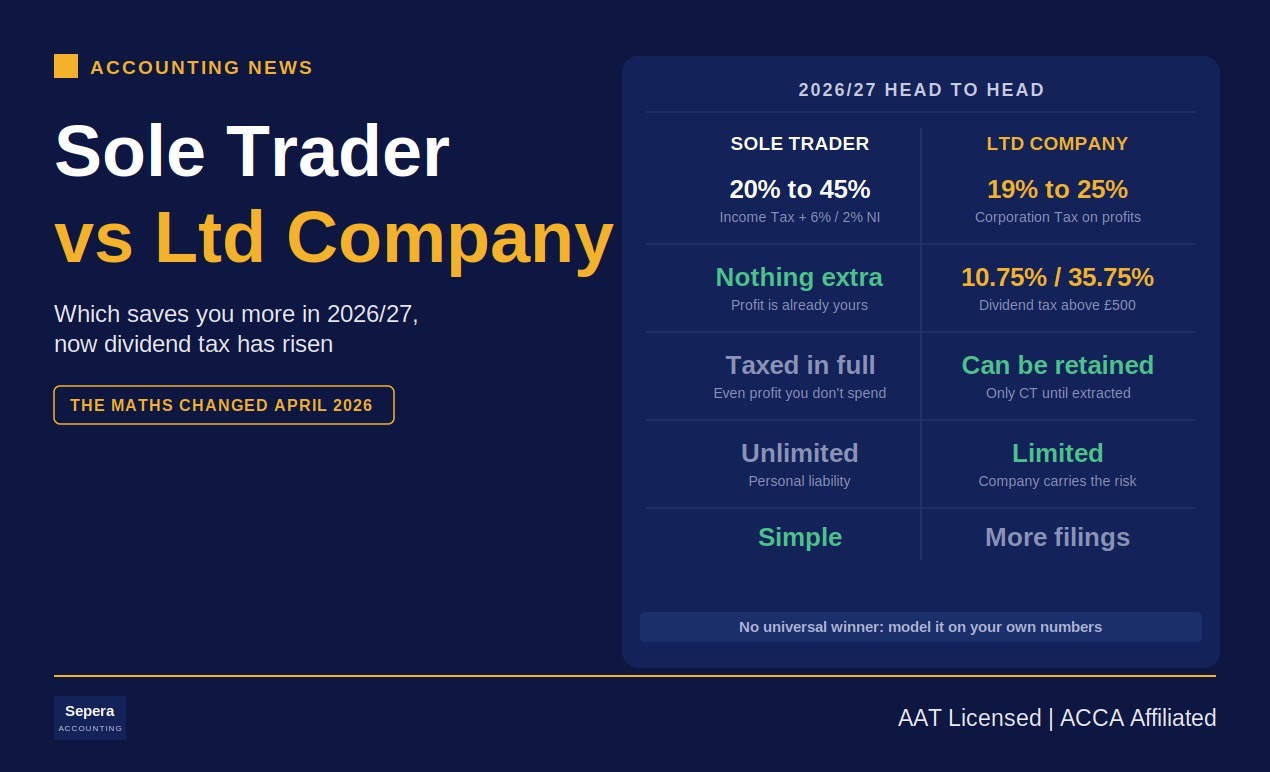
 Sole trader vs limited company is the question every UK business owner asks eventually, whether they’re starting out, growing fast, or wondering why their accountant hasn’t mentioned incorporation. And in 2026/27, the answer has genuinely shifted. The dividend tax rises that took effect in April 2026 narrowed the tax advantage of running a company, while corporation tax rates and the rules for the self-employed stayed put. The old rules of thumb are out of date.
At Sepera Accounting, we run this comparison for clients every week, so this guide gives you the full picture for 2026/27: what each structure pays, what changed in April 2026, the non-tax factors that matter just as much, and how to decide which side of the sole trader vs limited company line your business belongs on.
Sole Trader vs Limited Company: The Two Structures in Plain English
A sole trader is you, trading as yourself. The business’s profits are your income, its debts are your debts, and you report everything through Self Assessment. It’s the simplest structure in UK business, which is why most people start there.
A limited company is a separate legal entity registered at Companies House. The company earns the profits and pays its own tax, and you take money out as salary, dividends, or both. Your personal liability is generally limited to what you put in, hence the name. The official process for forming one is set out on GOV.UK.
The sole trader vs limited company decision is really two questions in one: which pays less tax on your numbers, and which structure fits how you want to run and grow the business. Most guides only answer the first, which is how people end up incorporated for a saving that evaporated two Budgets ago, or trading personally while carrying risks a company should be absorbing. This guide answers both, because in practice the second question decides the sole trader vs limited company contest at least as often as the tax does. Let’s take them in order.
What a Sole Trader Pays in 2026/27
As a sole trader, your profit is taxed as your personal income:
- Income Tax: 0% on the first £12,570 (personal allowance), 20% to £50,270, 40% to £125,140, 45% above that, with the allowance tapering away above £100,000
- Class 4 National Insurance: 6% on profits between £12,570 and £50,270, then 2% above
- Class 2 National Insurance: abolished as a compulsory charge, with state pension credits protected for most, and voluntary payments available for low profits
The structural point to understand: you’re taxed on all your profit in the year you earn it, whether you spend it, save it, or leave it in the business bank account. There’s no option to shelter profit at a lower rate for later.
What a Limited Company Pays in 2026/27
A company’s tax comes in two layers. First, the company pays Corporation Tax on its profits: 19% up to £50,000, 25% above £250,000, and an effective rate in between through marginal relief. Then you pay personal tax on what you extract:
- Salary: taxed like any employment income, and typically set at a modest level for owner-directors, though employer National Insurance applies at 15% above the £5,000 secondary threshold, and companies where the sole employee is also a director can’t use the Employment Allowance against it
- Dividends: paid from post-tax profits, with the first £500 tax free, then taxed at 10.75% in the basic rate band, 35.75% in the higher band, and 39.35% in the additional band for 2026/27
The company’s structural advantage is timing and control. Profit you don’t need personally can sit in the company having suffered only Corporation Tax, extracted in a later, lower-income year, invested, or used to grow the business. That flexibility is genuinely valuable, and it survives every rate change.
The April 2026 Change That Moved the Maths
From 6 April 2026, dividend tax rates rose by two percentage points in the basic and higher bands, from 8.75% to 10.75% and from 33.75% to 35.75%, with the additional rate unchanged at 39.35% and the allowance still just £500. Corporation Tax didn’t move, and neither did the sole trader’s rates.
The effect on the sole trader vs limited company comparison is straightforward: the total tax on the classic small-salary-plus-dividends strategy went up, so the profit level at which a company starts beating a sole trader has drifted higher, and for some owner-managers the gap has closed to very little. Anyone who incorporated years ago purely on tax grounds, and anyone still repeating “go limited once you hit £30,000”, is working from numbers that no longer exist. The honest answer in 2026/27 is that the winner depends on your specific profit, how much you need to extract, and your other income, which is why we model it rather than guess it.
It’s also worth watching the direction of travel. Recent Budgets have repeatedly tightened the screws on extracted profits, dividends up in 2026, property income rates rising in 2027, thresholds frozen throughout, while leaving Corporation Tax capped. If that pattern continues, the sole trader vs limited company answer will keep moving, and the businesses that win are the ones who review the question at each Budget rather than assuming last year’s answer still holds. A structure review takes an hour a year; running the wrong structure costs real money every month.
Sole Trader vs Limited Company at a Glance
Here’s the whole sole trader vs limited company comparison in one table for 2026/27:
| Factor (2026/27) | Sole trader | Limited company |
|---|---|---|
| Tax on profits | Income Tax 20% to 45% plus Class 4 NI | Corporation Tax 19% to 25%, then tax on extraction |
| Tax on money you take out | None extra, it’s already yours | Dividend tax 10.75% / 35.75% / 39.35% above £500, or PAYE on salary |
| Leave profit in the business | Taxed in full anyway | Only Corporation Tax until extracted |
| Personal liability | Unlimited | Generally limited |
| Privacy | No public filings | Accounts and details on public record |
| Admin and cost | Self Assessment, simpler records | Statutory accounts, Corporation Tax return, Companies House filings, payroll |
| Making Tax Digital | Applies above the income thresholds | Not within MTD for Income Tax |
Beyond Tax: The 5 Factors That Really Decide It
- Risk. If your work could generate claims bigger than your insurance, contracting, construction, anything advisory, limited liability is worth real money. A sole trader’s house is on the line; a shareholder’s generally isn’t.
- Who you sell to. Some corporate clients and agencies only engage limited companies. If your market expects a company, the sole trader vs limited company debate is settled for you.
- Growth plans. Companies can retain profit at Corporation Tax rates to fund growth, bring in shareholders, and are the natural vehicle if you’ll ever seek investment or sell the business.
- Admin appetite. A company brings statutory accounts, a Corporation Tax return, confirmation statements, payroll, and dividend paperwork. Handled by an accountant it’s painless, but it’s never zero.
- Digital reporting. Sole traders above the income thresholds are being brought into quarterly digital reporting, which we’ve covered fully in our Making Tax Digital for Income Tax guide. Companies sit outside that particular regime, though they have their own filing obligations.
One more for landlords specifically: property income has its own moving parts, including new property income tax rates from April 2027, and the incorporation question for rental portfolios follows different rules again. We’ve covered that side in our landlord tax guide.
When Each Structure Wins
Sole trader tends to win when:
- Profits are modest and you extract everything you earn anyway
- You value simplicity, low admin costs, and privacy
- Your liability risk is small or well insured
- You’re testing a business idea and may stop or pivot
Limited company tends to win when:
- Profits comfortably exceed what you need to live on, so retained profit works for you
- Liability protection matters for your trade
- Clients or agencies require a company
- You’re building something to grow, take investment into, or eventually sell
- There’s a second shareholder, often a spouse, whose allowances and bands can be used
Notice how few of those bullets are purely about this year’s tax rates. That’s the mature way to settle sole trader vs limited company: the tax comparison sets the price of each option, but the business factors usually pick the winner.
Sole Trader vs Limited Company: 3 Real-World Scenarios
Rules and rates are abstract, so here’s how the sole trader vs limited company question tends to resolve for three clients we see constantly. Names changed, patterns real.
Scenario 1: The £28,000 freelance designer
She takes every pound she earns to live on, has professional indemnity insurance covering her realistic risks, and hates paperwork. For her, sole trader vs limited company barely qualifies as a contest: a company would add accountancy fees, filings and dividend admin to save little or nothing at her profit level, especially after the April 2026 dividend rises. She stays a sole trader, keeps her records digital, and revisits the question if profits climb.
Scenario 2: The £85,000 IT contractor
His agency will only engage limited companies, which settles the structure before tax enters the conversation. But the tax layer still matters: he needs roughly £45,000 a year to live on, so the rest can stay in the company at Corporation Tax rates, funding a pension, a buffer, and eventually an exit. For him the sole trader vs limited company maths still favours the company, though by less than it did before April 2026, and the modelling is about extraction strategy rather than structure.
Scenario 3: The £55,000 builder with two subcontractors
His profits sit in the zone where the pure tax comparison is genuinely close in 2026/27. What tips it is risk: one bad job could produce a claim his insurance might not fully cover, and limited liability protects the family home. He incorporates for protection, accepts the extra admin as the premium, and takes the modest tax outcome either way. Sole trader vs limited company was never really a tax question for him at all.
Three businesses, three different deciding factors, and only one of them was tax. That’s the pattern we see over and over.
Can You Switch Between Structures?
Yes, in both directions, and people do. Sole traders incorporate when growth, risk or clients demand it, and the transfer of an existing business into a company has its own tax considerations worth planning properly. Companies can also be wound down in favour of returning to sole trader life when the admin outweighs the benefit. Neither move is irreversible, but both are easier and cheaper with advice taken before the switch rather than after. The one mistake to avoid is drifting: the sole trader vs limited company question deserves revisiting every few years, because running a structure that stopped suiting you several rate changes ago quietly costs money.
How Sepera Accounting Helps You Decide
The sole trader vs limited company decision deserves better than a rule of thumb, so we model it properly. Sepera Accounting is a London based, AAT licensed and ACCA affiliated practice serving sole traders, company directors, landlords and small businesses. We take your actual profit, your extraction needs and your other income, run both structures side by side under the 2026/27 rules, and give you the numbers along with the non-tax picture. If a company wins, we handle the formation, payroll and filings; if sole trader wins, we make Self Assessment and MTD painless. Either way, you decide with the real figures in front of you, and we put a reminder in the diary to rerun the sole trader vs limited company numbers when the rules next move. Get in touch with our team to run your numbers.
This article is general guidance based on the rules at the time of writing. Rates, thresholds and reliefs can change, and your circumstances are unique, so please contact us for advice tailored to you.
Frequently Asked Questions
Is it better to be a sole trader or a limited company in 2026/27?
It depends on your profit level, how much you extract, and your appetite for admin and risk. The April 2026 dividend tax rises narrowed the company’s tax advantage, so sole trader vs limited company needs modelling on your actual numbers rather than a rule of thumb. Non-tax factors like liability protection and client requirements often decide it.
How much tax does a sole trader pay in 2026/27?
Sole traders pay Income Tax at 20%, 40% or 45% on profits above the £12,570 personal allowance, plus Class 4 National Insurance at 6% on profits between £12,570 and £50,270 and 2% above that. Compulsory Class 2 National Insurance has been abolished.
How much tax does a limited company pay in 2026/27?
The company pays Corporation Tax at 19% on profits up to £50,000, 25% above £250,000, and an effective rate in between through marginal relief. The owner then pays tax on extraction: dividend tax at 10.75%, 35.75% or 39.35% above the £500 allowance, or PAYE on salary.
What changed for the sole trader vs limited company comparison in April 2026?
Dividend tax rates rose by two percentage points in the basic and higher bands, to 10.75% and 35.75%, while Corporation Tax and sole trader rates stayed the same. That raised the cost of the salary-plus-dividends strategy and pushed the profit level at which a company beats a sole trader higher.
At what profit level should I become a limited company?
There’s no universal threshold any more, and old figures like £30,000 predate several rate changes. The sole trader vs limited company crossover depends on how much profit you retain versus extract and your other income, so the reliable approach is modelling both structures on your own numbers.
Can I leave money in my limited company to save tax?
Yes, and it’s one of the structure’s main advantages. Retained profit suffers only Corporation Tax until you extract it, so it can fund growth, investment, or be drawn in a later year when your personal tax position is lower.
Does Making Tax Digital apply to limited companies?
Making Tax Digital for Income Tax applies to sole traders and landlords above the income thresholds, not to companies. Companies have their own obligations, including statutory accounts and Corporation Tax returns, and VAT-registered businesses of any structure are already within MTD for VAT.
Can I switch from sole trader to limited company later?
Yes. Many businesses start as sole traders and incorporate when growth, risk or client requirements justify it. Transferring an existing business into a company has tax considerations of its own, so plan the switch with an accountant before you make it.