 Making Tax Digital for Income Tax is the biggest change to the UK tax system in a generation, and it is no longer on the horizon. It is here. Since 6 April 2026, sole traders and landlords with qualifying income over £50,000 have been required to keep digital records and send quarterly updates to HMRC, and hundreds of thousands more will join from April 2027.
At Sepera Accounting, we’ve been helping London sole traders, landlords and small business owners move onto Making Tax Digital for Income Tax without stress. In this guide, we explain who is affected, when, what actually changes in practice, and what you should be doing now to prepare.
What Is Making Tax Digital for Income Tax?
Making Tax Digital (MTD) for Income Tax is HMRC’s programme to modernise how self-employed people and landlords report their income. Instead of one Self Assessment tax return filed once a year, affected taxpayers must:
- Keep digital records of business income and expenses in MTD compatible software
- Send quarterly updates to HMRC, four times a year, summarising income and expenses
- Submit a final declaration after the tax year ends, which brings together all income sources and confirms the final tax position
If that sounds familiar, it should. MTD started with VAT back in 2019, and Making Tax Digital for Income Tax extends the same digital approach to the self-employed and to landlords. Paper records and manual spreadsheets alone no longer meet the rules for those in scope.
Who Has to Use Making Tax Digital for Income Tax, and From When?
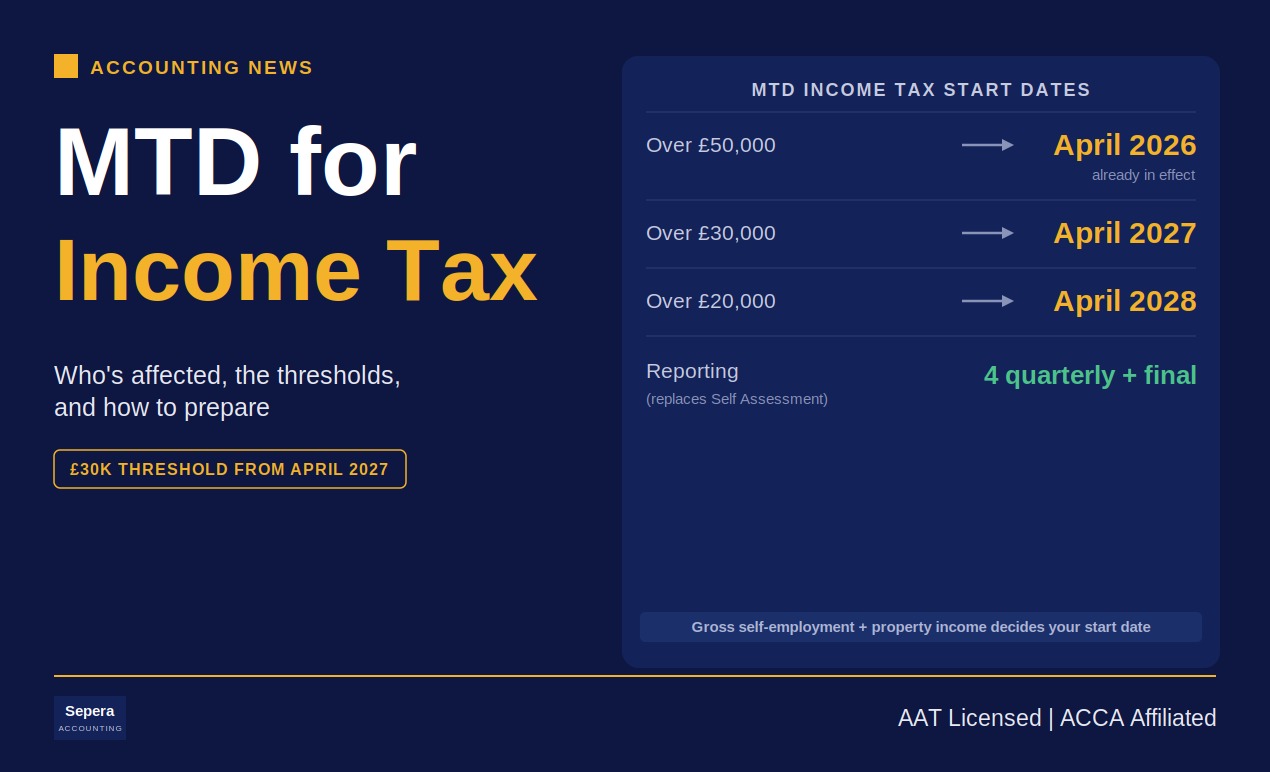
Making Tax Digital for Income Tax is being introduced in stages, based on your qualifying income. Qualifying income means your combined gross income from self-employment and property, before deducting any expenses. Wages under PAYE, dividends, pensions and savings interest do not count towards the threshold.
| Qualifying income | Assessed on tax return | MTD start date |
|---|---|---|
| Over £50,000 | 2024/25 | 6 April 2026 (already in effect) |
| Over £30,000 | 2025/26 | 6 April 2027 |
| Over £20,000 | 2026/27 | 6 April 2028 |
Two points catch people out. First, the test is on gross income, not profit. A landlord with £52,000 of rent and £30,000 of expenses is still over the £50,000 threshold. Second, income from self-employment and property is combined. If you have £27,000 of rental income and £25,000 of freelance income, you’re over £50,000 and in scope.
HMRC reviews your Self Assessment return each year and writes to you if you’ve crossed a threshold. But don’t wait for the letter. If your 2025/26 return shows qualifying income over £30,000, you should be preparing now for an April 2027 start under Making Tax Digital for Income Tax.
What Changes Under Making Tax Digital for Income Tax?
Quarterly updates replace the annual scramble
Under Making Tax Digital for Income Tax, you send HMRC a summary of your income and expenses every quarter through your software. The quarters follow the tax year, with each update due early in the month following the quarter end. Your accountant can prepare and submit these for you, exactly as many clients already do with VAT returns.
Digital record keeping becomes mandatory
Every business transaction needs to be recorded digitally in MTD compatible software. In practice, this often improves life rather than complicating it: cloud bookkeeping tools connect to your bank, capture receipts from your phone, and show you a live picture of your profit rather than a year-old snapshot.
The final declaration replaces the Self Assessment return
After the tax year ends, a final declaration pulls together your quarterly figures with any other income, such as employment, dividends or capital gains, and confirms your total tax bill. The 31 January payment deadline remains.
A new points-based penalty system
Late quarterly updates earn penalty points, and enough points trigger a financial penalty. The system is designed to be forgiving of one-off slips but firm on repeated lateness, which makes a reliable quarterly routine essential.
How to Prepare for Making Tax Digital for Income Tax
- Work out your qualifying income. Add up your gross self-employment and property income from your latest tax return. This tells you which start date applies to you. The official guidance on GOV.UK is the definitive reference.
- Choose MTD compatible software. Not every accounting tool qualifies. We help clients choose and set up cloud software that fits their business, and we handle the ongoing bookkeeping where they’d rather not. See our bookkeeping services.
- Digitise your records early. Moving from a shoebox of receipts or a spreadsheet to digital records is far easier done calmly, months in advance, than in a panic at the deadline.
- Build a quarterly rhythm. Four updates a year plus a final declaration means five touchpoints with HMRC instead of one. A simple monthly bookkeeping habit makes every quarterly deadline painless.
- Talk to your accountant. An accountant can sign you up, submit your quarterly updates, and make sure nothing is missed. If you don’t yet have one, or your current one hasn’t mentioned MTD, that’s a conversation worth having soon.
What If Your Income Is Below the Thresholds?
If your qualifying income is £20,000 or less, Making Tax Digital for Income Tax does not currently apply to you, and you can continue with Self Assessment as normal. You can join MTD voluntarily if the quarterly rhythm and digital records appeal, and for some clients that’s genuinely useful for staying on top of cash flow. Our self assessment service continues unchanged for clients outside MTD.
How Sepera Accounting Can Help
Sepera Accounting is a London based, AAT licensed and ACCA affiliated practice with over 30 years of combined experience supporting sole traders, landlords and small businesses. For Making Tax Digital for Income Tax, we offer a complete service: assessing when the rules apply to you, setting up compliant cloud software, taking over the digital bookkeeping, submitting your quarterly updates, and completing your final declaration. You carry on running your business, and we keep HMRC happy.
If you’d like a clear, jargon-free conversation about what Making Tax Digital for Income Tax means for your situation, get in touch with our team.
This article is general guidance based on the rules at the time of writing. Thresholds, dates and requirements can change, and your circumstances are unique, so please contact us for advice tailored to you.
Frequently Asked Questions
What is Making Tax Digital for Income Tax?
It is HMRC’s requirement for sole traders and landlords above certain income levels to keep digital records, send quarterly income and expense updates through MTD compatible software, and submit a final declaration after the tax year, replacing the single annual Self Assessment return.
Who has to use Making Tax Digital for Income Tax?
Sole traders and landlords with qualifying income over £50,000 have been required to use MTD since 6 April 2026. Those over £30,000 join from 6 April 2027, and those over £20,000 from 6 April 2028. Qualifying income is your gross self-employment and property income combined, before expenses.
Does Making Tax Digital apply to landlords?
Yes. Landlords are fully within Making Tax Digital for Income Tax. If your gross rental income, or your rental income combined with any self-employment income, exceeds the relevant threshold, you must keep digital records and send quarterly updates to HMRC.
Do wages, dividends and pensions count towards the MTD threshold?
No. Only gross income from self-employment and property counts as qualifying income. Employment income under PAYE, dividends, pensions and savings interest are excluded from the threshold test, although they are still reported in your final declaration.
How often do I report to HMRC under Making Tax Digital for Income Tax?
You send four quarterly updates a year through your software, each summarising income and expenses for that quarter, followed by a final declaration after the tax year ends. Your accountant can prepare and submit all of these on your behalf.
Can I still use a spreadsheet under Making Tax Digital for Income Tax?
Only if it is connected to HMRC through bridging software that meets MTD requirements. In practice, most people find dedicated MTD compatible cloud bookkeeping software easier, more accurate and more useful for running their business.
What happens if I miss a quarterly update?
HMRC operates a points based penalty system for late submissions. Each late update earns a point, and accumulating enough points triggers a financial penalty, so a reliable quarterly routine, or an accountant managing it for you, matters.
Can an accountant handle Making Tax Digital for Income Tax for me?
Yes. An accountant can set up your MTD compatible software, manage your digital bookkeeping, submit your quarterly updates and complete your final declaration. Sepera Accounting provides this as a complete service for sole traders, landlords and small businesses in London and beyond.