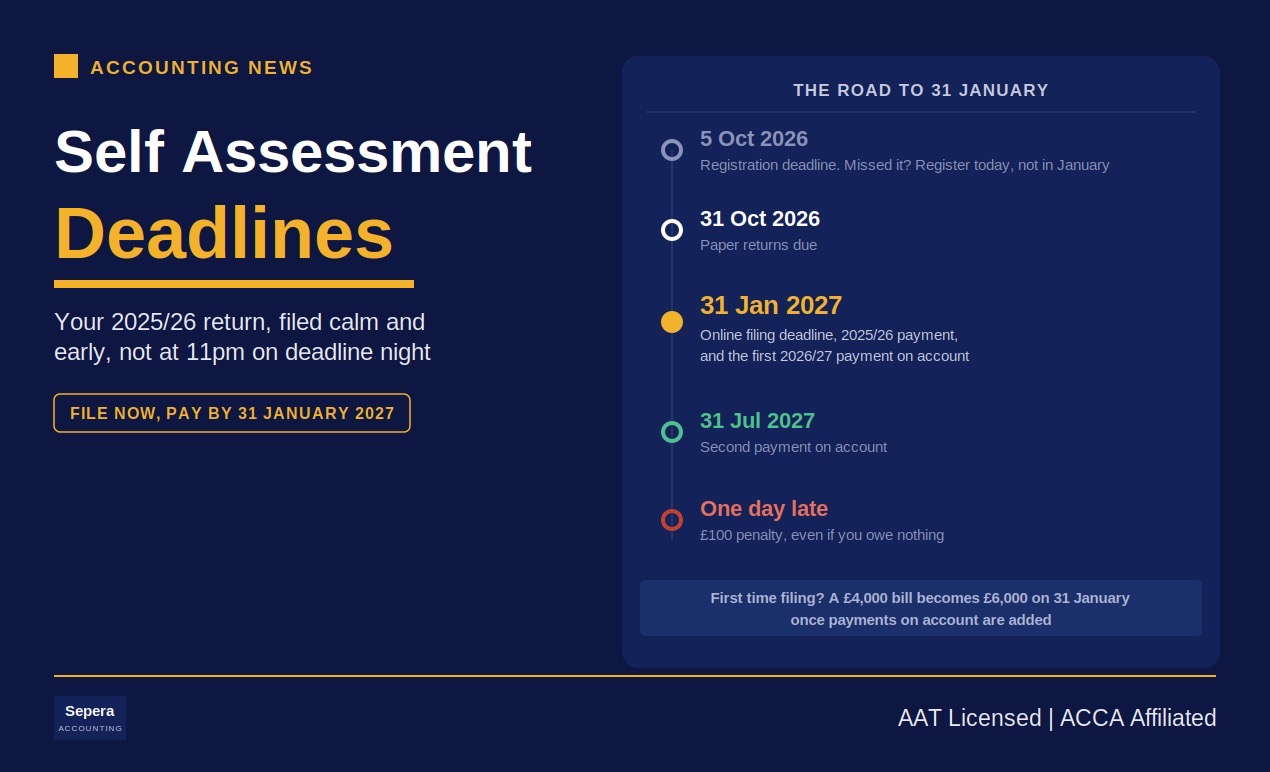
 Every January, HMRC’s systems strain under millions of last-minute filers, accountants everywhere cancel their evenings, and a predictable number of people pay £100 for the privilege of being a day late. It doesn’t have to be like that. Your Self Assessment tax return for the 2025/26 tax year (the year that ended 5 April 2026) can be filed any time from now, and the people who file in autumn get the same job done with less stress, better planning and occasionally an earlier refund.
At Sepera Accounting, a London practice serving sole traders, directors, landlords and small businesses, autumn is when we quietly file the returns of clients who like their Januaries calm. This guide covers everything the 2025/26 Self Assessment tax return involves: who has to file, every deadline that matters, how payments on account really work, what lateness costs, and the 7 steps that get it done properly.
Who Needs to File a Self Assessment Tax Return for 2025/26?
You’ll usually need to file for the year that ended 5 April 2026 if any of these applied to you during it:
- You were self-employed as a sole trader with gross income over £1,000 (the trading allowance threshold)
- You were a partner in a business partnership
- You had rental income above the £1,000 property allowance (and above £2,500 of profit the requirement is firm)
- You had dividends, savings interest or investment income above the allowances with tax to pay
- You made capital gains above the £3,000 annual exempt amount, or want to register losses, including crypto and property disposals
- You or your partner received Child Benefit while the higher earner’s income exceeded the High Income Child Benefit Charge threshold
- You had foreign income, or other untaxed income HMRC hasn’t collected through PAYE
Company directors, incidentally, don’t automatically need a return just for being directors, contrary to a stubborn myth; it’s the untaxed income that decides it. If you’re genuinely unsure, the checker on GOV.UK’s Self Assessment pages answers it in two minutes, or ask us and we’ll tell you straight, including when the answer is that you don’t need us.
One more group worth naming: people whose circumstances changed. Started renting out a flat in 2025/26, went freelance mid-year, exercised share options, began drawing a pension alongside work. A Self Assessment tax return often arrives in someone’s life on the back of one change like these, and the first year is precisely when the registration deadline, payments on account and record keeping habits all land at once. If that’s you, this guide was written with you particularly in mind.
Self Assessment Tax Return Deadlines for 2025/26
| What | Deadline |
|---|---|
| Register for Self Assessment (if newly required) | 5 October 2026, so if you’ve missed it, register immediately rather than waiting |
| Paper return | 31 October 2026 |
| Online return | Midnight, 31 January 2027 |
| Pay your 2025/26 tax bill | 31 January 2027 |
| First 2026/27 payment on account (where due) | 31 January 2027, alongside the balance |
| Second 2026/27 payment on account | 31 July 2027 |
Two notes on that table. First, the registration deadline has just passed as we publish this: if 2025/26 was your first year needing a Self Assessment tax return and you haven’t registered, do it now, because filing and paying on time can still spare you the worst outcomes, and delay compounds. Second, notice that 31 January 2027 is potentially three payments in one day: the 2025/26 balance, and the first payment on account towards 2026/27, which brings us to the section everyone wishes they’d read a year earlier.
7 Steps to File Your Self Assessment Tax Return Without Stress
- Confirm you’re registered and you can access your HMRC online account, including the UTR number every return needs. Recovering lost logins in January is its own circle of misery; test it in October.
- Gather income records by source. Sole trader income and expenses, rental statements and letting agent summaries, P60s and P45s, dividend vouchers, bank interest certificates, pension contributions, Gift Aid donations. One folder, one afternoon.
- Don’t forget the one-offs. Property or crypto disposals, redundancy payments, side income over £1,000. Gains on a sold rental property also have their own earlier reporting, covered in our guide to capital gains tax on rental property, and the Self Assessment return then reconciles it.
- Claim everything you’re entitled to. Allowable expenses, mileage, use of home, the Marriage Allowance where eligible, pension and Gift Aid relief for higher rate taxpayers. Most overpaid tax comes from rushed returns that claim too little, not bold ones that claim too much.
- Calculate, then sanity-check. The software does the arithmetic, but a human should ask whether the number looks right against last year, and why it moved.
- File and keep the evidence. Submit, save the confirmation, and keep records for at least five years after the filing deadline, because HMRC can ask.
- Plan the payment, including payments on account. Know the full 31 January figure in advance, and if cash is tight, look at HMRC’s Time to Pay arrangements before the deadline rather than after it.
Payments on Account: The Bill That Ambushes First-Time Filers
If your Self Assessment tax return shows more than £1,000 of tax due, and less than 80% of your tax was collected at source, HMRC assumes next year will look like this year and asks for it in advance: two payments on account, each half of this year’s bill, due 31 January and 31 July. It isn’t extra tax, it’s prepayment of next year’s, but nobody who meets it unprepared experiences it that way.
Numbers make the ambush visible. Suppose your 2025/26 bill is £4,000, none collected at source. On 31 January 2027 you owe the £4,000 balance plus a £2,000 first payment on account for 2026/27, £6,000 in total, with another £2,000 the following July. First-time filers who budgeted for £4,000 meet a bill 50% larger than expected, in the most expensive month of the year. The consolation: next January, those £4,000 of payments on account are already banked against your 2026/27 bill, so the cycle settles down. And if you know your income has fallen, payments on account can be reduced by claim, carefully, because over-reducing attracts interest.
What a Late Self Assessment Tax Return Actually Costs
- One day late: £100 fixed penalty, even if you owe no tax or are due a refund
- Three months late: £10 a day on top, for up to 90 days (another £900)
- Six and twelve months late: further penalties, each the higher of £300 or 5% of the tax due
- Late payment: separate 5% surcharges at 30 days, 6 months and 12 months, plus interest running daily on everything unpaid
A return that’s a year late can comfortably cost £1,600 or more in penalties before a penny of the actual tax, which is why “I didn’t owe much so I didn’t bother” is the most expensive sentence in Self Assessment. Note especially the first line: the £100 arrives even when no tax is due at all, catching people who assumed a nil bill meant a nil obligation. If you have missed deadlines and HMRC has been writing to you, the fix is a properly handled catch-up, and the sooner it starts the smaller it ends.
The MTD Wrinkle: Why This January Is Different
From April 2026, sole traders and landlords with qualifying income over £50,000 entered Making Tax Digital for Income Tax, keeping digital records and sending HMRC quarterly updates. Here’s what confuses people this winter: being in MTD for 2026/27 does not change your 2025/26 Self Assessment tax return, which still has to be filed the traditional way by 31 January 2027. You can be submitting quarterly updates for the current year and still owe HMRC last year’s return in the old format, in the same month.
So this January is a bridge year: the old regime’s deadline with the new regime running alongside it. If you’re above the £50,000 threshold and haven’t sorted digital record keeping, or you’re near the £30,000 threshold arriving in April 2027, the full timeline and software options are in our guide to Making Tax Digital for Income Tax. Filing this return early buys you the breathing room to get the MTD side right too.
5 Mistakes That Cost Self Assessment Filers Real Money
- Forgetting income HMRC already knows about. Bank interest, dividends and side platform income increasingly reach HMRC automatically. A Self Assessment tax return that omits them doesn’t hide them; it just invites a letter. Declare everything and let the allowances do their work.
- Claiming too little. Use of home, mileage at approved rates, professional subscriptions, pension and Gift Aid relief for higher rate taxpayers: these are the quiet hundreds that rushed filers leave behind every year. Higher rate pension relief alone goes unclaimed on an industrial scale, because people assume the pension provider’s 20% is the whole story.
- Mixing up allowable and non-allowable expenses. Client entertaining isn’t deductible, clothing almost never is, and the grey areas (phone bills, home office, mixed-use subscriptions) need apportioning, not guessing. Confident wrong claims are enquiry bait.
- Ignoring the payments on account line. As above, the January total is often 150% of the bill people expect. Reading the calculation to the bottom, or having someone translate it, prevents the single most common Self Assessment shock.
- Treating the return as a January job. Every mistake on this list is a symptom of rushing. The same Self Assessment tax return, prepared in October, gets checked, optimised and paid on time. Deadlines punish lateness, but the real money is lost to haste.
The Case for Filing Your Self Assessment Tax Return Early
Filing in autumn rather than January changes nothing about what you owe and everything about how it feels:
- You learn the bill months before you pay it. Filing in October tells you January’s number with time to save towards it. Filing on 30 January tells you the same number with 24 hours’ notice.
- Refunds arrive sooner. If you’ve overpaid, filing early starts the repayment clock now rather than in the new year queue.
- Mistakes get caught. Rushed January returns miss reliefs and mistype figures. Autumn returns get checked properly, by you and by us.
- Tax code and budgeting options open up. Owing under £3,000 and filing by 30 December can let PAYE collect it through next year’s tax code instead of one lump sum.
- January becomes an ordinary month. Which, for anyone who has refreshed the HMRC login page at 11pm on deadline night, is worth more than any of the above.
There’s a quieter benefit too: an early Self Assessment tax return is a planning document, not just a compliance one. Seeing 2025/26’s final numbers in October, while 2026/27 is barely half over, leaves time to act on what they show: pension contributions, timing of income, whether the structure still suits you. File in January and the numbers arrive too late to change anything.
How Sepera Accounting Handles Your Return
Sepera Accounting is a London based, AAT licensed and ACCA affiliated practice with over 30 years of combined experience preparing Self Assessment tax returns for sole traders, directors, landlords and investors. You send us the records once; we prepare the return, claim every relief you’re entitled to, explain the bill and the payments on account in plain English, file it, and diarise the lot so no deadline ever surprises you again. Sorting a late return or several missed years is work we handle quietly and without judgement, and bilingual service in English and Polish is part of the practice. To get your 2025/26 Self Assessment tax return filed early, get in touch with our team now, while January is still far away.
This article is general guidance based on the rules at the time of writing. Deadlines, penalties and thresholds can change, and your circumstances are unique, so please contact us for advice tailored to you.
Frequently Asked Questions
When is the Self Assessment tax return deadline for 2025/26?
Online returns and payment are due by midnight on 31 January 2027. Paper returns are due earlier, by 31 October 2026, and any first payment on account for 2026/27 is also due on 31 January 2027.
Who has to file a Self Assessment tax return?
Broadly: sole traders with gross income over £1,000, business partners, landlords above the property allowance, people with investment income or capital gains above the allowances, those within the High Income Child Benefit Charge, and anyone with untaxed or foreign income HMRC can’t collect through PAYE.
What happens if I file my Self Assessment tax return late?
A £100 penalty applies immediately, even if you owe nothing. After three months, £10 daily penalties run for up to 90 days, with further penalties at six and twelve months, plus separate surcharges and interest on late payment. A year’s delay commonly exceeds £1,600 before the tax itself.
What are payments on account?
Advance payments towards next year’s tax, required when your bill exceeds £1,000 and less than 80% was collected at source. Each is half of this year’s bill, due 31 January and 31 July, so a first-time £4,000 bill becomes £6,000 on 31 January once the first payment on account is added.
Can I reduce my payments on account?
Yes, if you reasonably expect next year’s income to be lower, you can claim to reduce them. Reduce them below what the final bill turns out to need and HMRC charges interest on the shortfall, so base the claim on evidence rather than optimism.
Do I still file a Self Assessment tax return if I’m in Making Tax Digital?
Yes, for 2025/26 you do. MTD quarterly updates began in April 2026 for sole traders and landlords over £50,000, covering 2026/27 onwards, but the 2025/26 Self Assessment tax return is still filed the traditional way by 31 January 2027.
I missed the 5 October registration deadline. What should I do?
Register immediately rather than waiting. What matters most is filing and paying by 31 January 2027, and prompt registration now usually keeps you on track for that. Leaving it makes every later step tighter.
Is it worth paying an accountant for a Self Assessment tax return?
For straightforward PAYE-only affairs, often not. For sole traders, landlords, directors and anyone with disposals or multiple income sources, a good accountant typically recovers their fee through properly claimed reliefs, prevented errors and penalty-free deadlines, and removes the January stress entirely.