 Landlord tax has never moved faster than it is moving right now. Rental profits are still taxed at the familiar income tax rates this year, but from April 2027 rental income shifts onto new, higher property income tax rates, mortgage interest relief continues under the Section 24 rules, digital reporting is rolling out, and the capital gains allowance remains a fraction of what it once was.
At Sepera Accounting, landlords and property investors are the clients we serve most, so this landlord tax guide pulls everything together in one place: what you pay for 2026/27, how Section 24 really works, which expenses you can still claim, what happens when you sell, and exactly what changes in April 2027.
Landlord Tax on Rental Income in 2026/27
If you own property personally, your rental profit (rental income minus allowable expenses) is added to your other income and taxed at normal income tax rates this year:
| Band (2026/27) | Taxable income | Rate on rental profit |
|---|---|---|
| Personal allowance | Up to £12,570 | 0% |
| Basic rate | £12,571 to £50,270 | 20% |
| Higher rate | £50,271 to £125,140 | 40% |
| Additional rate | Over £125,140 | 45% |
Both the personal allowance and the higher rate threshold are frozen, which quietly pulls more landlords into higher bands each year as rents rise. It’s a stealth increase in landlord tax that no Budget speech ever announces. HMRC’s rules on what counts as property income are set out in the official guidance on GOV.UK.
The April 2027 Landlord Tax Change: New Property Income Rates
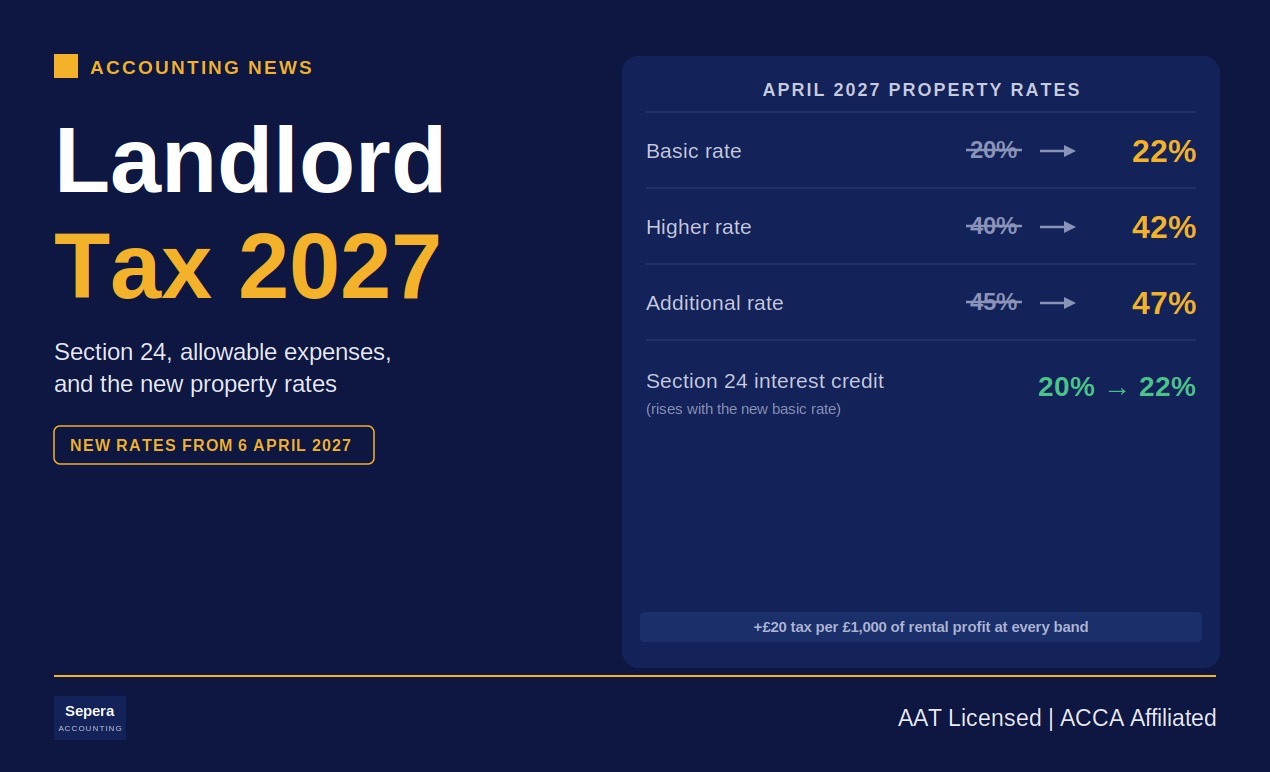
This is the landlord tax change to plan for now. From April 2027, rental income will no longer be taxed at the standard income tax rates. Instead, it moves onto separate, higher property income rates of 22%, 42% and 47%, two percentage points above the equivalent standard bands. Part of the reasoning is that rental income carries no National Insurance, so property income is being brought closer to the tax paid on wages.
In practical terms, a higher rate landlord will pay an extra £20 of tax for every £1,000 of rental profit from April 2027. It isn’t dramatic on its own, but stacked on frozen thresholds and Section 24, it’s another squeeze on personally held property, and one more reason to review your structure before the new rates land.
Section 24: How Mortgage Interest Relief Really Works
No part of landlord tax causes more confusion than Section 24. Since 2020, individual landlords cannot deduct mortgage interest or other finance costs from rental income. Instead, you calculate tax on your profit before interest, then receive a basic rate tax reducer, worth 20% of your finance costs for 2026/27 (subject to caps based on your property profits and total income).
Two consequences catch landlords out:
- Higher rate taxpayers get less relief than they pay. Profit may be taxed at 40% while the interest credit is only worth 20%, so every £1,000 of mortgage interest costs a higher rate landlord roughly £200 more than under the old rules.
- Gross profit can push you over thresholds. Because interest no longer reduces your headline profit, your total income figure is higher on paper. That can tip you into the higher rate band, taper your personal allowance above £100,000, or affect child benefit, even though your real cash position hasn’t changed.
One small silver lining: from April 2027 the reducer is set to rise to 22%, tracking the new property basic rate, so the credit keeps pace with the rate change.
Allowable Expenses: What Landlords Can Still Claim
With interest relief restricted, claiming every legitimate expense is the simplest way to reduce your landlord tax bill. Deductible costs include:
- Letting agent and property management fees
- Repairs and maintenance (genuine repairs, not improvements, which are capital costs)
- Buildings and contents insurance
- Ground rent and service charges
- Utilities and council tax you pay as the landlord
- Accountancy fees for your rental business
- Advertising for tenants, and certain legal fees for shorter lets
Alternatively, if your rental income is small, the £1,000 property allowance lets you receive up to £1,000 of property income tax free instead of claiming expenses. It’s one or the other, so landlords with real running costs almost always do better claiming actual expenses.
Landlord Tax When You Sell: Capital Gains
Selling a rental property triggers Capital Gains Tax on the gain above your £3,000 annual exempt amount, at 18% within the basic rate band and 24% above it. Purchase and sale costs, plus genuine capital improvements, reduce the gain. With the allowance down from £12,300 only a few years ago, almost every property sale now produces a taxable gain, so it pays to plan disposals, and the timing of them, in advance.
Digital Reporting: MTD Is Arriving for Landlords
Making Tax Digital changes how landlord tax is reported rather than how much you pay. It already applies to landlords with gross qualifying income over £50,000, with the threshold falling to £30,000 from April 2027 and £20,000 from April 2028. Joint owners are assessed on their individual share. If that’s you, quarterly digital reporting replaces the single annual return. We’ve covered the full rules, deadlines and preparation steps in our Making Tax Digital for Income Tax guide.
Should Landlords Use a Limited Company?
With Section 24 and the new property rates applying to individuals, incorporation keeps coming up, and for some landlords it genuinely helps: companies deduct mortgage interest in full and pay Corporation Tax rather than the new property income rates. But moving existing properties into a company can trigger Capital Gains Tax and Stamp Duty Land Tax on the transfer, and extracting profits has its own tax costs. It’s a decision to model properly with an accountant, not a rule of thumb, because the right answer depends on your mortgage size, income level, and long term plans.
How Sepera Accounting Helps Landlords
Landlord tax is our specialist ground. Sepera Accounting is a London based, AAT licensed and ACCA affiliated practice, and property landlords are at the heart of our client base. We prepare rental accounts and Self Assessment returns, apply Section 24 correctly, plan for the April 2027 property rates, advise on company versus personal ownership with full modelling, and get MTD-ready bookkeeping in place before your threshold date arrives. For a clear picture of your own position, get in touch with our team.
This article is general guidance based on the rules at the time of writing. Rates, thresholds and reliefs can change, and your circumstances are unique, so please contact us for advice tailored to you.
Frequently Asked Questions
How much tax do landlords pay on rental income?
For 2026/27, rental profit is added to your other income and taxed at 20%, 40% or 45% depending on your band, after the £12,570 personal allowance. From April 2027, rental income moves onto separate property income rates of 22%, 42% and 47%.
What is changing for landlord tax in April 2027?
Rental income will be taxed at new property income tax rates of 22%, 42% and 47%, two percentage points above the standard income tax rates. The Section 24 mortgage interest reducer rises alongside it, from 20% to 22%, to track the new property basic rate.
Can landlords still claim mortgage interest?
Not as a direct deduction. Under Section 24, individual landlords receive a tax reducer worth 20% of their finance costs in 2026/27 instead. Higher rate taxpayers therefore get less relief than the tax rate they pay on the profit, and the gross profit calculation can push income over key thresholds.
What expenses can a landlord claim against rental income?
Common allowable expenses include letting agent fees, genuine repairs and maintenance, landlord insurance, ground rent, service charges, utilities and council tax paid by the landlord, advertising for tenants, and accountancy fees. Improvements are capital costs and reduce your gain when you sell instead.
How much Capital Gains Tax do landlords pay when selling a property?
Gains above the £3,000 annual exempt amount are taxed at 18% within the basic rate band and 24% above it. Purchase and selling costs and capital improvements reduce the taxable gain.
Does Making Tax Digital apply to landlords?
Yes. Landlords with gross qualifying income over £50,000 are already in Making Tax Digital for Income Tax, the threshold drops to £30,000 from April 2027 and £20,000 from April 2028, and joint owners are assessed on their individual share. Quarterly digital updates replace the single annual return.
Is it better for a landlord to own property through a limited company?
Sometimes. Companies deduct mortgage interest in full and are outside the new property income rates, but transferring existing properties can trigger Capital Gains Tax and Stamp Duty Land Tax, and taking profits out of the company has its own tax costs. It needs proper modelling for your specific circumstances rather than a general rule.
Do I need an accountant for landlord tax?
If you have a mortgage, more than one property, higher rate income, or you’re approaching the MTD thresholds, a specialist usually saves more than they cost. Section 24 interactions, expense claims, CGT planning and the April 2027 rate change are all areas where good advice directly reduces what you pay.