 IR35 has just seen its most significant change since the 2021 private sector reforms. From 6 April 2026, the size thresholds that decide whether a business falls inside or outside the off-payroll working rules increased substantially, moving a meaningful number of medium-sized companies out of scope entirely. If you are a contractor operating through a limited company, or a business that engages contractors, this changes who is responsible for determining IR35 status and who carries the compliance risk.
At Sepera Accounting, we support both contractors and the businesses that engage them across London and Stockport. This guide explains exactly what IR35 is, what changed in April 2026, and what you need to do about it depending on which side of the engagement you sit on.
What Is IR35?
IR35, formally known as the off-payroll working rules, is UK tax legislation designed to ensure that someone working through a personal service company (PSC) but who, in practice, works like an employee, pays broadly the same Income Tax and National Insurance as an employee would. The rules exist to prevent what HMRC calls disguised employment, where a genuine employment relationship is structured through a limited company purely to reduce tax.
IR35 applies to a worker providing services to a client through an intermediary, typically their own limited company, where the underlying reality of the working relationship resembles employment rather than genuine self-employment. What matters under IR35 is working reality, not what the contract says on paper. A contract that describes someone as self-employed does not protect against IR35 if the day-to-day relationship looks like employment.
Who Decides IR35 Status: Client vs Contractor
Since the private sector reforms in April 2021, responsibility for determining IR35 status has depended on the size of the client engaging the contractor, not the contractor themselves in most cases.
Medium and large clients are responsible for assessing each contractor engagement and issuing a Status Determination Statement (SDS), a written document stating whether the engagement falls inside or outside IR35, with reasons. If the client determines the contractor is inside IR35, the fee payer must operate PAYE and National Insurance on the payments made.
Small clients are exempt from this responsibility. Where the end client is classified as small under the Companies Act 2006 criteria, the contractor’s own personal service company remains responsible for assessing IR35 status under the original legislation, Chapter 8 of ITEPA 2003.
What Changed on 6 April 2026
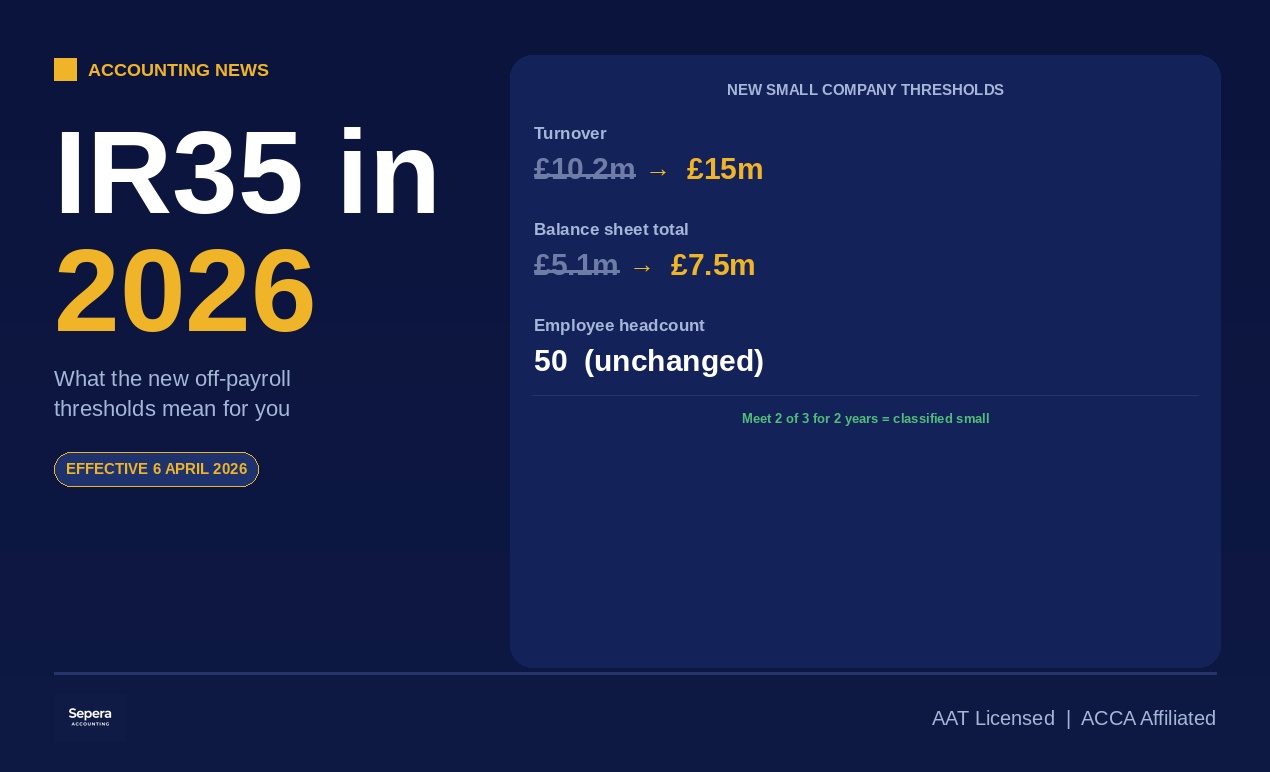
HMRC confirmed that the size thresholds used to classify a company as small for IR35 purposes increased in line with the wider Companies Act size threshold changes. From 6 April 2026, two of the three qualifying thresholds rose:
- Turnover: increased from £10.2 million to £15 million
- Balance sheet total: increased from £5.1 million to £7.5 million
- Employee headcount: remains unchanged at 50 employees
A company qualifies as small if it meets at least two of the three thresholds for two consecutive financial years. Because of the higher turnover and balance sheet limits, a substantial number of businesses previously classed as medium have now moved into the small category, taking them entirely outside the IR35 reforms and shifting status determination responsibility back onto the contractor’s own limited company.
It is worth noting that because the size test looks at two consecutive years of accounts, most clients will not feel the practical effect of reclassification until closer to the 2027/28 tax year, even though the threshold change itself took effect from April 2026. You can read HMRC’s official guidance on the off-payroll working rules at GOV.UK.
What This Means If You Are a Contractor
If your client has been reclassified as small following the April 2026 threshold changes, responsibility for determining your IR35 status transfers from your client back to you and your personal service company. This is a meaningful shift in both administrative burden and financial risk.
Practical steps worth taking now:
Request written confirmation of your client’s size. Under the off-payroll rules, a contractor can formally request confirmation from their client of whether they are classified as small, medium, or large. The client has 45 days to respond. If you have not received a Status Determination Statement recently and previously did, it is worth checking whether your client has been reclassified.
Reassess your IR35 status for each active engagement. If responsibility has shifted to you, you now need a current, documented assessment of your working arrangements against the standard employment status tests: control, substitution, and mutuality of obligation being the core factors HMRC and tribunals consider.
Keep the documentation. If HMRC later queries your status, having a reasoned, contemporaneous assessment is far stronger evidence than reconstructing your reasoning after the fact.
What This Means If You Engage Contractors
If your business has grown, or the threshold increases mean your accounts now qualify as small for two consecutive years, you may find your compliance obligations under IR35 have reduced. This is not, however, a reason to stop reviewing contractor engagements altogether.
Confirm your current size classification. Check your last two years of turnover, balance sheet total, and headcount against the new thresholds to establish whether you now qualify as small.
Communicate clearly with contractors. If you are moving from medium to small classification, contractors need to know that responsibility for their own status determination has shifted to them. Silence here creates confusion and risk on both sides.
Understand the new Joint and Several Liability rules. From April 2026, Joint and Several Liability (JSL) rules apply to umbrella company arrangements within the labour supply chain. Where PAYE is not correctly operated, HMRC can recover unpaid tax from other parties in the chain, including agencies and, in some circumstances, the end client. This makes due diligence on umbrella companies and agencies in your supply chain more important, not less, even where you personally fall outside IR35 as a small business.
How IR35 Status Is Actually Determined
Regardless of who is responsible for making the determination, the underlying tests have not changed. HMRC and tribunals look at the working reality of the relationship, weighing factors including:
- Control: how much say the client has over what, how, when, and where the work is done
- Substitution: whether the contractor could genuinely send a substitute to do the work in their place
- Mutuality of obligation: whether the client is obliged to offer work and the contractor obliged to accept it
- Financial risk: whether the contractor bears genuine business risk, such as correcting unsatisfactory work at their own cost
- Integration: how embedded the contractor is within the client’s organisation, such as use of company email, appraisals, or line management
No single factor is decisive. HMRC’s own Check Employment Status for Tax (CEST) tool can be used to help form a view, but it is not legally binding and has been criticised for not fully reflecting case law in borderline cases. A written assessment that considers the full working relationship carries more weight than a CEST result alone.
The Cost of Getting IR35 Wrong
An incorrect IR35 determination, whether made by a contractor’s own PSC or by a client that should have issued an SDS, carries real financial consequences. If HMRC successfully challenges a status determination, the liable party can face backdated PAYE and National Insurance, interest on the unpaid amounts, and potentially penalties depending on whether HMRC considers the error careless or deliberate.
For businesses engaging contractors through payroll and employer support services, getting the status determination and PAYE treatment right from the outset avoids a much more expensive correction exercise later. For contractors operating through a limited company, our limited company accounting service includes support reviewing engagements against current IR35 criteria.
How Sepera Accounting Helps With IR35
Whether you are a contractor navigating a newly reclassified client, or a business working out whether the April 2026 threshold changes affect your obligations, getting this right matters. We support both sides of the IR35 relationship: reviewing individual engagements, advising on documentation, and ensuring PAYE is operated correctly where an engagement is genuinely inside IR35.
We are an AAT-licensed, ACCA-affiliated practice with over 30 years of combined experience supporting contractors and businesses across London and Stockport. Get in touch via our contact page or call us on +44 20 7071 8676 to review your current engagements against the 2026 threshold changes.
Frequently Asked Questions: IR35
What is IR35?
IR35, also known as the off-payroll working rules, is UK tax legislation ensuring that contractors who work through a personal service company but whose working reality resembles employment pay broadly the same Income Tax and National Insurance as an employee. It applies based on the substance of the working relationship, not the wording of the contract.
What changed with IR35 in April 2026?
From 6 April 2026, the size thresholds used to classify an end client as small for IR35 purposes increased: turnover rose from £10.2 million to £15 million, and balance sheet total rose from £5.1 million to £7.5 million. Employee headcount remained at 50. This moved a significant number of previously medium-sized businesses into the small category, taking them outside the 2021 IR35 reforms.
Who is responsible for determining IR35 status?
Medium and large clients are responsible for issuing a Status Determination Statement for each contractor engagement. Small clients are exempt, meaning responsibility falls back on the contractor’s own personal service company under the original legislation.
What is a Status Determination Statement?
A Status Determination Statement (SDS) is a written document a medium or large client must provide to the contractor and the fee payer, stating whether the engagement is inside or outside IR35 and giving the reasons for that conclusion.
How do I find out if my client counts as small under the new IR35 thresholds?
A contractor can formally request written confirmation of their client’s size classification under the off-payroll working rules. The client has 45 days to respond. Checking whether you have received a Status Determination Statement recently is also a useful practical signal.
What factors determine whether someone is inside or outside IR35?
Key factors include control over how, when, and where work is done, whether genuine substitution is possible, mutuality of obligation, financial risk borne by the contractor, and how integrated the contractor is within the client’s organisation. No single factor is decisive; the overall working reality is assessed.
What happens if an IR35 determination is wrong?
If HMRC successfully challenges an incorrect determination, the liable party can face backdated PAYE and National Insurance, interest, and potentially penalties depending on whether the error is considered careless or deliberate.
What is Joint and Several Liability under the new IR35 rules?
From April 2026, Joint and Several Liability rules apply to umbrella company arrangements within the labour supply chain. Where PAYE is not correctly operated, HMRC can recover unpaid tax from other parties, including agencies and, in some cases, the end client, making supply chain due diligence important even for businesses outside IR35 scope.
Is HMRC’s CEST tool reliable for checking IR35 status?
HMRC’s Check Employment Status for Tax tool can help form an initial view, but it is not legally binding and has faced criticism for not fully reflecting case law in borderline situations. A documented assessment considering the full working relationship carries more weight than a CEST result alone.
Do the new IR35 thresholds apply immediately from April 2026?
The threshold change took effect from 6 April 2026, but because company size is assessed over two consecutive years of accounts, most businesses will not feel the practical reclassification effect until closer to the 2027/28 tax year.
This article provides general guidance on IR35 and the off-payroll working rules in the UK. Tax rules and thresholds can change. Please contact us for advice tailored to your specific engagement.