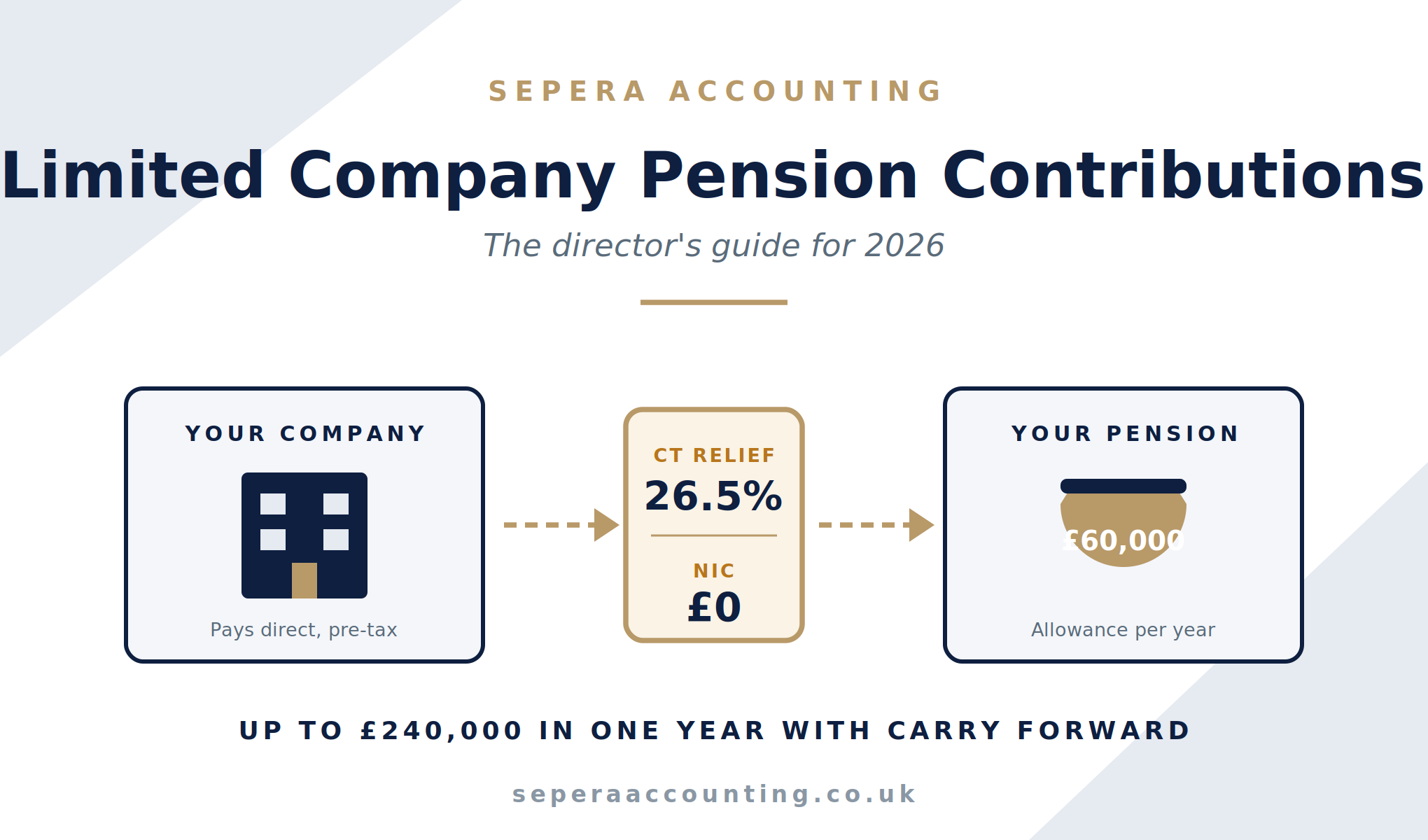
 Limited company pension contributions are the most generous tax break left for owner-managed businesses, and the one directors use least well. Paid directly by your company, a pension contribution gets corporation tax relief at up to 26.5%, attracts no employer National Insurance, no employee National Insurance and no income tax on the way in, and is not capped by the size of your salary. No other way of extracting value from your company comes close, and the April 2026 rise in dividend tax rates has widened the gap further.
This guide explains how limited company pension contributions work in 2026/27: the £60,000 annual allowance and how carry forward can multiply it, why employer contributions beat personal ones for most directors, the wholly and exclusively test, the taper for high earners, and the traps that turn a great planning tool into an HMRC problem.
Why employer contributions beat everything else
To see why limited company pension contributions win, compare the routes for getting £10,000 of company money into your hands or your future:
- Salary: The company pays employer NI at 15% on top, you pay income tax and employee NI. A large slice disappears before it reaches you.
- Dividends: Paid from post-corporation-tax profit, then taxed again personally at rates that rose by 2 percentage points in April 2026.
- Employer pension contribution: The company pays £10,000 into your pension. Corporation tax relief on the full amount. No employer NI. No employee NI. No income tax now. The full £10,000 goes to work for you.
The corporation tax relief on limited company pension contributions alone is worth 19% to 25% depending on your profit level, and companies with profits in the £50,000 to £250,000 marginal band get relief at an effective 26.5%, the highest rate in the corporation tax system. On top of that, a £60,000 contribution paid as pension instead of salary saves the company £9,000 of employer NI at the 2026/27 rate.
The trade-off is obvious and real: pension money is locked away until pension access age, and tax applies when you eventually draw it (beyond the tax-free lump sum). Limited company pension contributions are long-term planning, not income replacement. The right structure for most directors combines a modest salary, dividends for living costs, and company pension contributions for everything the household does not need this year. Our salary vs dividends guide covers the extraction side of that structure.
The annual allowance: £60,000 for 2026/27
The ceiling on limited company pension contributions is the annual allowance, which for 2026/27 is £60,000. That is the total pension input from all sources across all schemes: your personal contributions, all limited company pension contributions made for you, and any third-party amounts. Exceed it and the excess is added to your taxable income and charged at your marginal rate.
Two features of the allowance matter enormously for directors:
- Personal contributions are capped at 100% of your relevant UK earnings. A director on the classic £5,000 to £12,570 low-salary structure can only make tiny personal contributions with tax relief, because dividends do not count as relevant earnings.
- Employer contributions are not subject to the earnings cap. Your company can contribute up to the full £60,000 for you even if your salary is £5,000. This single rule is why limited company pension contributions, not personal ones, are the default planning route for owner-managers.
Carry forward: contributing up to £240,000 in one year
Limited company pension contributions can go beyond £60,000 in one year using carry forward: unused annual allowance from the three previous tax years can be used, provided you were a member of a registered pension scheme in those years. For 2026/27 that means unused allowance from 2023/24, 2024/25 and 2025/26, giving a theoretical maximum of £240,000 of limited company pension contributions in a single year.
Carry forward suits the way owner-managed businesses actually make limited company pension contributions: profits are lumpy, and a strong year is exactly when a large one-off contribution makes sense. A company sitting on surplus cash after a good year can make a large contribution, sweep profits out of the 26.5% marginal band, and bank three years of unused allowance in one move. The current year’s allowance is used first, then the earliest carried-forward year.
Records matter here: you (or we) need to evidence the unused allowance for each year, including contributions made to any scheme by any route.
The wholly and exclusively test
Limited company pension contributions are deductible for corporation tax only if they are incurred wholly and exclusively for the purposes of the trade. For a working director, HMRC’s practical question is whether the overall remuneration package (salary, benefits and pension together) is commercially reasonable for the work done.
For a director actively running the business, even large limited company pension contributions are rarely challenged by HMRC: the director generates the profits, and rewarding that work is a business purpose. The situations that attract attention are contributions for people who do little or no work for the company, most commonly a spouse or family member added to the payroll with a token role and a large pension contribution. If the total package for a non-working spouse would look absurd as salary, it does not become defensible by being paid as pension.
Timing also matters: relief is given for the accounting period in which the contribution is actually paid, not accrued. A contribution intended to reduce this year’s corporation tax must physically leave the company bank account before the year end.
High earners: the tapered annual allowance
Directors with large total income need to check the taper before making large limited company pension contributions, because the taper can shrink the room available:
- Gateway: if your threshold income (broadly, net income excluding pension contributions) is £200,000 or less, the taper does not apply at all.
- Taper: where threshold income exceeds £200,000 and adjusted income (threshold income plus employer pension contributions) exceeds £260,000, the allowance reduces by £1 for every £2 over £260,000.
- Floor: the minimum tapered allowance is £10,000, reached at adjusted income of £360,000.
Note the circularity: limited company pension contributions themselves count towards adjusted income, so a very large contribution can partially erode the allowance it is trying to use. For directors near these thresholds the contribution size needs modelling, not guessing.
Other limits and changes to know in 2026
- Money Purchase Annual Allowance (£10,000): a hard limit on further limited company pension contributions if you have flexibly accessed any pension (drawdown income or lump sums beyond the 25% tax-free amount), your allowance for further money purchase contributions drops to £10,000. Directors semi-retiring while keeping the company running trip over this constantly.
- Lifetime allowance abolished: gone since April 2024. The remaining ceiling is on tax-free cash: the lump sum allowance is £268,275 for most people.
- Pensions enter inheritance tax from April 2027: unused pension funds will count in the IHT estate from 6 April 2027. Pensions remain excellent retirement planning, but the old strategy of treating them primarily as an IHT shelter is ending, and estate plans built on it need revisiting.
- Annual allowance charges: if you do exceed the allowance, the excess is taxed at your marginal rate through Self Assessment, and scheme pays can settle the charge from the pension pot where the excess is significant.
Practical structure for a typical director
Putting the limited company pension contributions rules together, the pattern we implement most often at Sepera Accounting:
- Salary at or around the NI Secondary Threshold to secure the state pension credit at minimal cost.
- Dividends sized to the household’s actual spending needs, not to the available profit.
- Limited company pension contributions absorbing surplus profit, prioritised in years where profits sit in the 26.5% marginal band, using carry forward after strong years.
- Payment before year end, evidenced from the company account, with the remuneration package documented as commercially reasonable.
The sequencing of limited company pension contributions matters as much as the amounts: contributions planned in the final month of the accounting period, after the profit picture is clear, capture relief precisely where it is worth most.
Frequently Asked Questions
How much can my limited company pay into my pension in 2026/27?
Up to the £60,000 annual allowance from all sources, subject to the wholly and exclusively test, and potentially up to £240,000 using carry forward from the three previous tax years. Employer contributions are not limited by your salary level, unlike personal contributions.
Do limited company pension contributions save corporation tax?
Yes. They are an allowable business expense in the accounting period they are paid, saving corporation tax at 19% to 25%, and at an effective 26.5% for profits in the £50,000 to £250,000 marginal relief band. They also avoid employer and employee National Insurance entirely.
Can my company pay into my pension if I only take a small salary?
Yes. The 100%-of-earnings cap applies only to personal contributions. Employer contributions can be made up to the full annual allowance regardless of salary, which is exactly why the employer route is standard for directors on low-salary, dividend-based structures.
Can my company make pension contributions for my spouse?
Only defensibly if your spouse genuinely works in the business and their total remuneration package, including the pension, is commercially reasonable for that work. Contributions for non-working family members fail the wholly and exclusively test and the corporation tax deduction can be refused.
What happens if contributions exceed the annual allowance?
The excess is added to your taxable income and charged at your marginal rate through Self Assessment. Carry forward from the three prior years can absorb an apparent excess if unused allowance exists. Where the charge is significant, scheme pays allows it to be settled from the pension pot.
Get your limited company pension contributions structured properly
Limited company pension contributions sit at the intersection of corporation tax, National Insurance, personal tax and retirement planning, and the difference between a well-timed, well-sized contribution and a casual one is measured in thousands of pounds a year. The allowance rules, the taper, the payment timing and the wholly and exclusively test all reward doing this deliberately.
At Sepera Accounting we model the right contribution level against your profits and the marginal relief band, check taper and carry forward positions, and time payments to your year end. Get in touch to review your position before your accounting year closes. For the official allowance rules, see gov.uk’s annual allowance guidance.