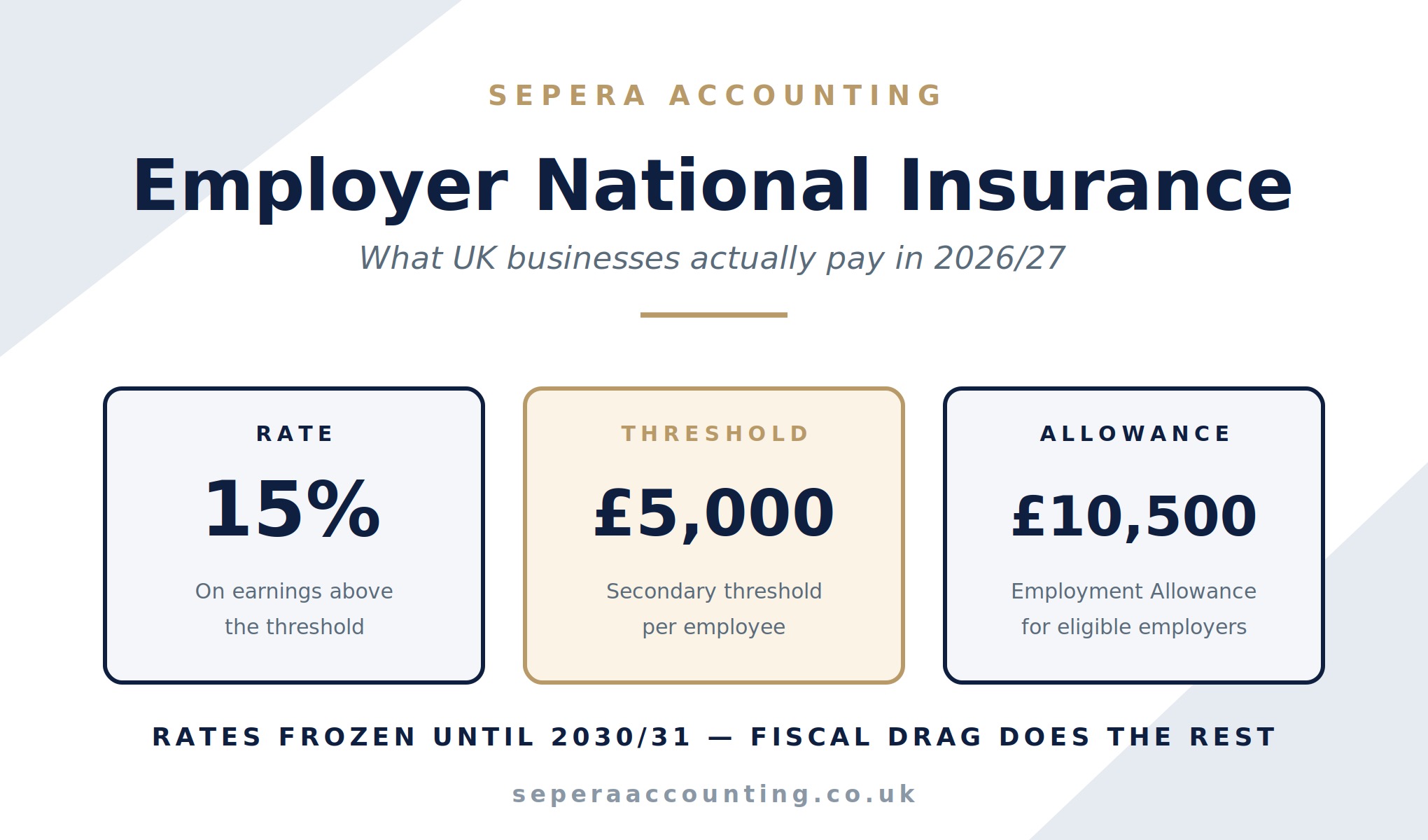
 The employer national insurance bill is one of the biggest hidden costs of running a UK business in 2026. Since the rate rose to 15% and the threshold dropped to £5,000 in April 2025, employer national insurance has stopped being a background number and started being a genuine planning constraint. Small businesses are paying materially more per employee than they were two years ago, and the Autumn 2025 Budget confirmed the position stays frozen until 2030/31.
If you employ staff or pay yourself a salary as a director, the maths of employer national insurance in 2026/27 matters more than it used to. Get the Employment Allowance claim wrong, misclassify a young worker, or forget the £5,000 threshold and you can leave thousands of pounds on the table across a tax year.
This guide sets out the current rates and thresholds, the Employment Allowance rules that let eligible businesses knock £10,500 off the bill, worked examples showing what the tax actually costs at different salary levels, and the mistakes most owner-managers make.
What is employer national insurance?
Employer national insurance, technically “secondary Class 1 National Insurance contributions”) is a payroll tax paid by the employer on top of an employee’s salary. It is not deducted from the employee’s pay. It is a genuine cost to the business, on top of the gross wage.
The tax applies to earnings above a threshold called the Secondary Threshold. For 2026/27 that threshold is £5,000 per year. Every pound of salary above £5,000 attracts NIC at the headline rate.
Employer national insurance rates and thresholds for 2026/27
The key figures for the tax year running from 6 April 2026 to 5 April 2027 are:
- Employer NIC rate: 15%.
- Secondary Threshold: £5,000 per year (£96 per week, £417 per month).
- Employment Allowance: £10,500 per year for eligible employers.
- Upper Secondary Threshold for under 21s and apprentices under 25: £50,270 per year. Zero employer NIC below this figure for eligible workers.
- Class 1A rate (on benefits in kind): 15%.
- Class 1B rate (PAYE Settlement Agreements): 15%.
- Lower Earnings Limit: £6,708 per year (£129 per week) from April 2026, up from £6,500 in 2025/26.
The rate, Secondary Threshold, Employment Allowance and personal tax thresholds are all frozen until 2030/31. Fiscal drag will do the rest of the work for HMRC as wages rise. Every pay rise increases the employer national insurance bill even when the headline rate does not move.
The £5,000 secondary threshold explained
The Secondary Threshold is where employer national insurance starts biting. Before April 2025 it sat at £9,100. From April 2025 it dropped to £5,000, and the 2026/27 tax year keeps it there. That £4,100 reduction means an extra £4,100 of every employee’s salary now attracts 15% employer national insurance that did not before.
For a business with 10 employees, that reduction alone increases the annual bill by roughly £6,150 (£4,100 x 15% x 10). This is the change that has hit small employers hardest, more so than the headline rate rise from 13.8% to 15%.
The threshold applies per employee, not per employer. Every worker paid above £5,000 a year triggers NIC regardless of whether they are full-time, part-time or a director. The only exceptions are the under-21 and under-25 apprentice categories, plus specific reliefs for veterans and Freeport workers.
Employment Allowance 2026/27: how to claim £10,500 off your bill
The Employment Allowance is the single most valuable relief against employer national insurance in 2026/27. Eligible employers can offset up to £10,500 of Class 1 employer national insurance liability per year. Claimed correctly, it effectively wipes out the first £10,500 of your annual employer NIC bill.
Eligibility rules that catch owner-managers out:
- You must have at least one non-director employee earning above the Secondary Threshold. A limited company with only one director and no other staff cannot claim.
- The £100,000 prior-year NIC liability cap has been removed. Larger businesses that were previously excluded can now claim.
- Connected companies count as one. If you run several companies under common control, only one can claim.
- Public sector employers, personal service companies and IR35-caught contractors are excluded.
- The allowance offsets Class 1 employer NIC only. It cannot be used against Class 1A (benefits in kind) or Class 1B (PSA) liabilities.
The allowance is claimed through your payroll software each pay run. It offsets against employer NIC as it accrues, so businesses with lower NIC bills exhaust it later in the tax year, and businesses with higher bills use it up earlier and start paying full NIC from that point onwards.
Worked examples: what employer national insurance actually costs
The maths is straightforward once you have the figures. For each employee, take the annual salary, subtract the £5,000 Secondary Threshold, and multiply by 15%.
Some concrete 2026/27 examples for standard Category A employees:
- Employee on £15,000 salary: (£15,000 – £5,000) x 15% = £1,500 employer national insurance per year.
- Employee on £30,000 salary: (£30,000 – £5,000) x 15% = £3,750 employer national insurance per year.
- Employee on £50,000 salary: (£50,000 – £5,000) x 15% = £6,750 employer national insurance per year.
- Employee on £75,000 salary: (£75,000 – £5,000) x 15% = £10,500 employer NIC per year. This single employee’s NIC exhausts the entire Employment Allowance.
- Employee on £100,000 salary: (£100,000 – £5,000) x 15% = £14,250 employer national insurance per year.
These figures are pure employer NIC. On top of the salary, they represent the real cost to your business of employing that person before pension contributions, benefits and other on-costs.
For a business with an eligible Employment Allowance claim, subtract £10,500 from the total annual NIC bill. A business employing five people at £30,000 each pays £18,750 in gross employer NIC (5 x £3,750). After the £10,500 allowance, the net cost is £8,250.
How to reduce your employer national insurance bill
Legitimate ways to lower your employer national insurance liability in 2026/27:
- Claim the the allowance if eligible. A surprising number of small companies do not, either through payroll software misconfiguration or because they wrongly believe they are excluded.
- Consider younger workers and apprentices. Employees under 21 and apprentices under 25 attract zero NIC on salaries up to £50,270. For roles suited to entry-level candidates, this is a meaningful saving.
- Review director salary strategy. Owner-managers often benefit from setting a director salary at exactly the Secondary Threshold (£5,000) to trigger the NI credit for state pension without any NIC liability, then taking dividends for the balance. Read our salary vs dividends guide for the current maths.
- Use salary sacrifice for pensions. Pension contributions made through salary sacrifice reduce the gross salary and therefore the employer NIC bill. Both employer and employee benefit.
- Consider newly-exempt benefits. From April 2026, employer reimbursements for homeworking equipment, eye tests and flu jabs become NIC-exempt when processed through payroll. Reviewing your benefits mix for these can produce useful savings.
- Check veteran and Freeport reliefs. If you employ former armed forces personnel or workers in designated Freeport or Investment Zone locations, specific reliefs apply.
Common employer national insurance mistakes
The errors that catch UK employers out most often in 2026/27:
- Not claiming Employment Allowance when eligible. The single most valuable relief and the one most often left on the table by companies that assume they do not qualify.
- Claiming Employment Allowance when a sole director. If your company only has one director and no other employees above the Secondary Threshold, the claim is invalid and HMRC will recover it plus penalties.
- Missing the connected-company rule. Running multiple companies and claiming Employment Allowance on each is a common and expensive mistake.
- Misclassifying under-21s or apprentices. Failing to apply the correct Category letter means paying NIC you did not need to pay.
- Running old payroll settings after 6 April. If your payroll software has not been updated for the new tax year, you will calculate NIC on last year’s figures and either overpay or underpay.
- Forgetting Class 1A on benefits. NIC at 15% applies to the taxable value of benefits reported on P11D. Missed reporting means underpaid NIC and penalties.
- Late monthly payment. The NIC payment must reach HMRC by the 22nd of the following month for electronic payments, 19th if paying by cheque. Late payments attract interest and, over time, penalties.
Frequently Asked Questions
What is the employer national insurance rate for 2026/27?
The rate for the tax year running 6 April 2026 to 5 April 2027 is 15%. This is unchanged from 2025/26 and applies to all earnings above the £5,000 Secondary Threshold. Class 1A (benefits in kind) and Class 1B (PSA) rates are also 15%.
What is the Secondary Threshold for employer national insurance?
The Secondary Threshold for 2026/27 is £5,000 per year. This is the point at which employer NIC becomes payable. It has been frozen at £5,000 since April 2025 and is due to remain frozen until 2030/31.
Can I still claim Employment Allowance in 2026/27?
Yes, if you are an eligible employer. The allowance is £10,500 for 2026/27, and the previous £100,000 prior-year NIC cap has been removed, meaning more businesses qualify. Sole-director companies with no other employees cannot claim. Connected companies count as one for the allowance.
Do I pay employer national insurance on directors’ salaries?
Yes. Directors are subject to the same 15% employer national insurance rate as any other employee, applied to earnings above the £5,000 Secondary Threshold. Their NIC is normally calculated on an annual cumulative basis rather than per pay period.
Do I pay employer national insurance on benefits in kind?
Yes. Class 1A NIC at 15% applies to the taxable value of most benefits in kind reported on P11D, including company cars, private medical insurance and other reportable benefits. Class 1A is paid annually, due by 22 July after the tax year end.
Get the employer national insurance calculation right first time
Employer NIC in 2026/27 is not the invisible payroll cost it used to be. The rate rise, the threshold drop and the freeze on thresholds until 2030/31 mean the maths matters more than ever, and small errors compound quickly across a full tax year.
At Sepera Accounting we help UK businesses model their liability, claim the Employment Allowance correctly, review director salary strategy against dividend planning, and make sure the payroll set-up is right from the start of each tax year. Get in touch for a clear review of your position. For official HMRC rates and thresholds see the gov.uk rates and thresholds page.