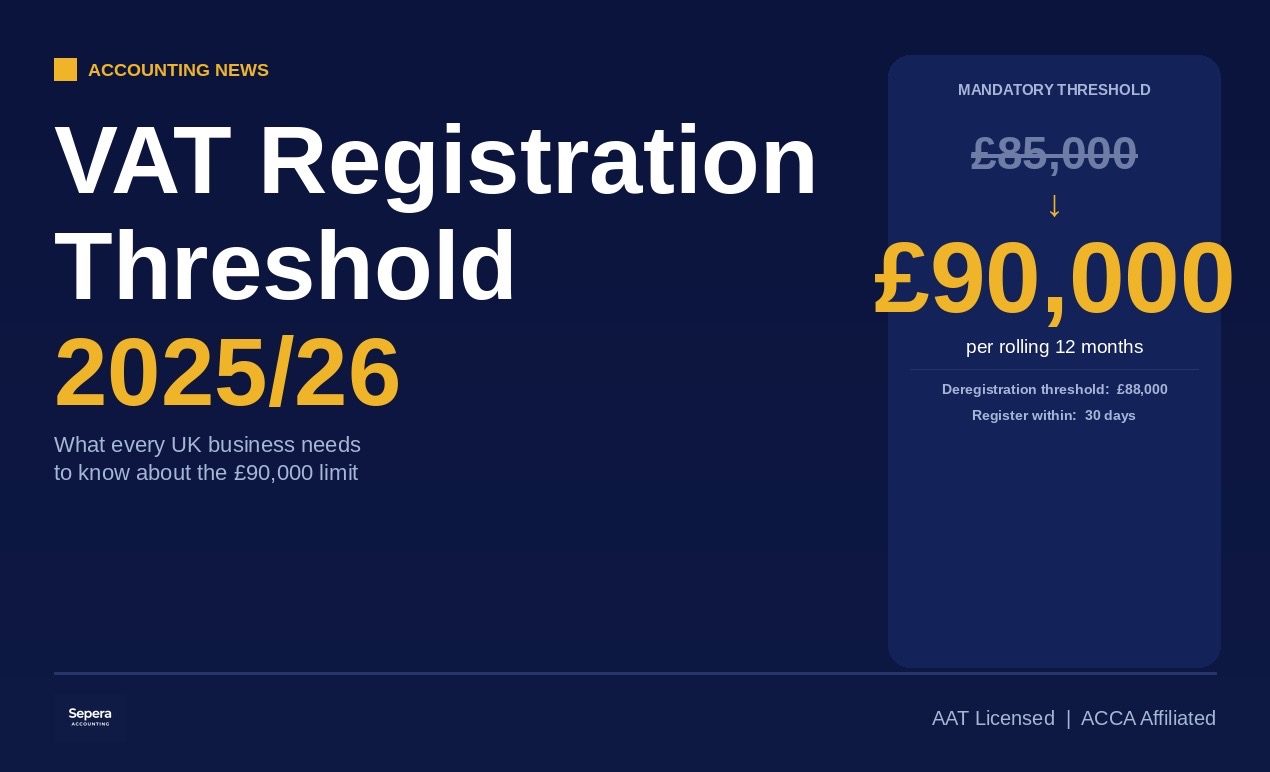
 The VAT registration threshold is the point at which your business must register for VAT with HMRC. For 2025/26 that figure is £90,000 in taxable turnover over any rolling 12-month period. Cross it and you have 30 days to register. Miss that deadline and you face backdated VAT liability, penalties, and interest.
At Sepera Accounting, we help sole traders, limited companies, and growing businesses across London and Stockport manage their VAT obligations from registration through to quarterly returns. This guide explains exactly how the VAT registration threshold works, what counts toward it, and what to do if you are approaching the limit.
What Is the VAT Registration Threshold?
The VAT registration threshold is the annual turnover level above which a UK business must register for Value Added Tax. Once registered, you are required to charge VAT on your taxable sales, reclaim VAT on eligible business purchases, and submit regular VAT returns to HMRC.
VAT is not calculated on profit. It is calculated on your taxable turnover, which is the total value of sales that are subject to VAT at any rate, including standard rate (20%), reduced rate (5%), and zero rate (0%). Exempt sales do not count toward the VAT registration threshold.
The Current VAT Registration Threshold for 2025/26
The VAT registration threshold for the 2025/26 tax year is £90,000. This was increased from £85,000 in April 2024 and has remained unchanged for 2025/26. The government has not announced any further increase for 2026.
The deregistration threshold, which is the level your turnover must fall below before you can voluntarily deregister, is £88,000. This is set deliberately lower than the VAT registration threshold to prevent businesses from repeatedly hopping in and out of the VAT system due to minor fluctuations in turnover.
You can view the current rates and thresholds on the official HMRC VAT registration page on GOV.UK.
How the VAT Registration Threshold Is Calculated
This is where many businesses come unstuck. The VAT registration threshold is not calculated on a fixed April-to-April tax year. It is measured on a rolling 12-month basis, which means HMRC looks at any consecutive 12-month period, not just the last financial year.
In practice, this means you need to check your cumulative taxable turnover at the end of every calendar month. If at the end of any given month your total taxable sales over the preceding 12 months have exceeded £90,000, you have breached the VAT registration threshold and the clock starts ticking.
A common mistake is assuming that because your annual accounts show turnover below the threshold, you are safe. If you had a strong run of sales between, say, March and February of any given year, your rolling 12-month figure could exceed £90,000 even if neither financial year individually does.
The Two 30-Day Rules and the VAT Registration Threshold
There are two separate triggers that can create a VAT registration obligation, and both involve a 30-day window.
Historic test: If your taxable turnover has exceeded the VAT registration threshold over the past 12 months, you must notify HMRC within 30 days of the end of the month in which you crossed it. Your effective date of registration will be the first day of the following month.
Future test: If you believe your taxable turnover will exceed the VAT registration threshold in the next 30 days alone, you must notify HMRC immediately. Your effective date of registration will be the start of that 30-day period, not the end.
The future test catches businesses that win a large contract unexpectedly. If you secure a deal worth £100,000 to be delivered next month and you have not yet registered, the future test applies from the day you are certain the turnover will be exceeded.
What Counts Towards the VAT Registration Threshold?
Not all income counts toward the VAT registration threshold. The key rule is that only VAT-taxable supplies are included.
The following count toward the threshold:
- Standard-rated sales (20% VAT)
- Reduced-rate sales (5% VAT)
- Zero-rated sales (0% VAT, such as most food and children’s clothing)
The following do not count toward the threshold:
- Exempt supplies (such as most financial services, insurance, and private education)
- Outside-the-scope supplies
- One-off sales of capital assets used in the business
If your business makes only exempt supplies, you will never trigger the VAT registration threshold on a mandatory basis, though you may still choose to register voluntarily in certain circumstances. Our VAT registration service includes a full review of which sales count toward your threshold.
Should You Register for VAT Voluntarily?
You can register for VAT at any time, even if your turnover is below the VAT registration threshold. Voluntary registration makes sense in certain situations.
Reclaim VAT on purchases. If you spend significantly on VAT-bearing costs (equipment, premises, professional services), voluntary registration allows you to reclaim that input VAT. For a business spending £20,000 a year on VAT-bearing costs, that is £4,000 recovered.
B2B credibility. Many larger businesses prefer to deal with VAT-registered suppliers. A VAT number on your invoices signals an established business and can open doors to contracts that might otherwise go elsewhere.
Approaching the threshold. If your turnover is close to £90,000, voluntary registration now avoids a rushed mandatory registration later and gives you time to set up systems properly.
The trade-off is administrative burden. You will need to charge VAT on your sales, which increases your prices for non-VAT-registered customers. For businesses selling primarily to consumers rather than businesses, this can be a competitive disadvantage. Our accounting team can model both scenarios for your specific situation.
What Happens If You Miss the VAT Registration Threshold?
Failing to register on time after breaching the VAT registration threshold is one of the more costly mistakes a business can make. HMRC can:
- Register you with a backdated effective date from when you should have registered
- Charge you the VAT that should have been collected on all sales since that date
- Apply a failure-to-notify penalty ranging from 10% to 30% of the VAT owed, depending on how late the registration is and whether the error was deliberate
- Charge interest on any unpaid VAT from the date it was due
The painful reality is that you owe the backdated VAT whether or not you actually collected it from your customers. If you charged your clients without VAT for 18 months before registering, you cannot go back and recover that VAT from them. The liability falls entirely on you.
Voluntary disclosure before HMRC discovers the error always results in lower penalties than waiting for an audit. If you believe you may have missed your registration date, contact our team immediately. Early disclosure can significantly reduce the financial impact.
VAT Schemes Available After Registration
Once you have crossed the VAT registration threshold and registered, several schemes are available to simplify your VAT accounting.
Flat Rate Scheme: You pay a fixed percentage of your gross turnover to HMRC rather than tracking input and output VAT separately. Best suited to businesses with low input VAT costs. Available up to £150,000 taxable turnover.
Cash Accounting Scheme: You account for VAT when payment is actually received or made, rather than on invoice date. Useful for businesses with slow-paying customers. Available up to £1.35 million taxable turnover.
Annual Accounting Scheme: You file one VAT return per year and make advance payments throughout the year. Reduces administration. Available up to £1.35 million taxable turnover.
Choosing the wrong scheme can cost you more than the standard method. Our self-employed accounting service and limited company service both include VAT scheme advice as standard.
How Sepera Accounting Manages Your VAT Registration Threshold
Monitoring your rolling 12-month turnover against the VAT registration threshold is not something you should be doing manually. A missed month, a miscategorised sale, or a sudden surge in revenue can push you over the line without warning.
At Sepera Accounting, we track our clients’ VAT registration threshold position as part of our year-round service. We alert you when you are approaching £90,000, advise on the optimal timing for registration, handle the HMRC registration process on your behalf, and set up your VAT returns on the correct scheme from day one.
We are an AAT-licensed, ACCA-affiliated practice with over 30 years of combined experience. Get in touch via our contact page or call us on +44 20 7071 8676. Full details of our VAT service are on our VAT registration and returns page.
Frequently Asked Questions: VAT Registration Threshold
What is the VAT registration threshold for 2025/26?
The VAT registration threshold for 2025/26 is £90,000 in taxable turnover over any rolling 12-month period. This figure has been unchanged since April 2024 when it increased from £85,000.
How is the VAT registration threshold calculated?
The VAT registration threshold is measured on a rolling 12-month basis, not on your financial year or tax year. You must check your cumulative taxable turnover at the end of every calendar month. If it has exceeded £90,000 in any consecutive 12-month window, you must register within 30 days.
What happens if I exceed the VAT registration threshold late?
HMRC will backdate your registration to when you should have registered and charge the VAT that should have been collected since that date. A failure-to-notify penalty of 10% to 30% of the outstanding VAT also applies, plus interest. The VAT is owed whether or not you collected it from customers.
Does zero-rated income count toward the VAT registration threshold?
Yes. Zero-rated sales such as most food, children’s clothing, and printed books count toward the VAT registration threshold even though no VAT is charged on them. Only truly exempt supplies, such as most financial services and private education, are excluded.
Can I register for VAT voluntarily before reaching the threshold?
Yes. Voluntary registration is available to any business regardless of turnover. It is worth considering if you have significant VAT-bearing costs to reclaim, if your customers are mainly VAT-registered businesses, or if you are approaching the £90,000 threshold and want to prepare in advance.
What is the VAT deregistration threshold?
The VAT deregistration threshold is £88,000. If you are already VAT registered and your taxable turnover falls below this level, you can apply to deregister. It is set lower than the VAT registration threshold to prevent businesses from switching in and out of VAT registration repeatedly.
What VAT schemes are available after I register?
The main schemes are the Flat Rate Scheme, the Cash Accounting Scheme, and the Annual Accounting Scheme. Each suits different business types. The Flat Rate Scheme is often beneficial for service businesses with low input costs. An accountant can calculate which scheme saves you the most money.
Do I need an accountant to register for VAT?
You can register directly with HMRC online, but many businesses use an accountant to ensure the correct effective date is used, the right VAT scheme is selected from day one, and all historic turnover is correctly categorised before registration. Getting this wrong at the outset is difficult to correct later.
Will the VAT registration threshold increase in 2026?
The government has not announced any increase to the VAT registration threshold for 2026. The threshold has been £90,000 since April 2024. Any changes would normally be announced at a Budget or Spring Statement.
What is Making Tax Digital and how does it affect VAT?
Making Tax Digital for VAT requires all VAT-registered businesses to keep digital records and submit VAT returns using HMRC-compatible software. It has applied to all VAT-registered businesses since April 2022, regardless of turnover. You cannot submit VAT returns manually once registered.
This article provides general guidance on the VAT registration threshold for 2025/26. VAT rules and thresholds can change. Please contact us for advice tailored to your business.