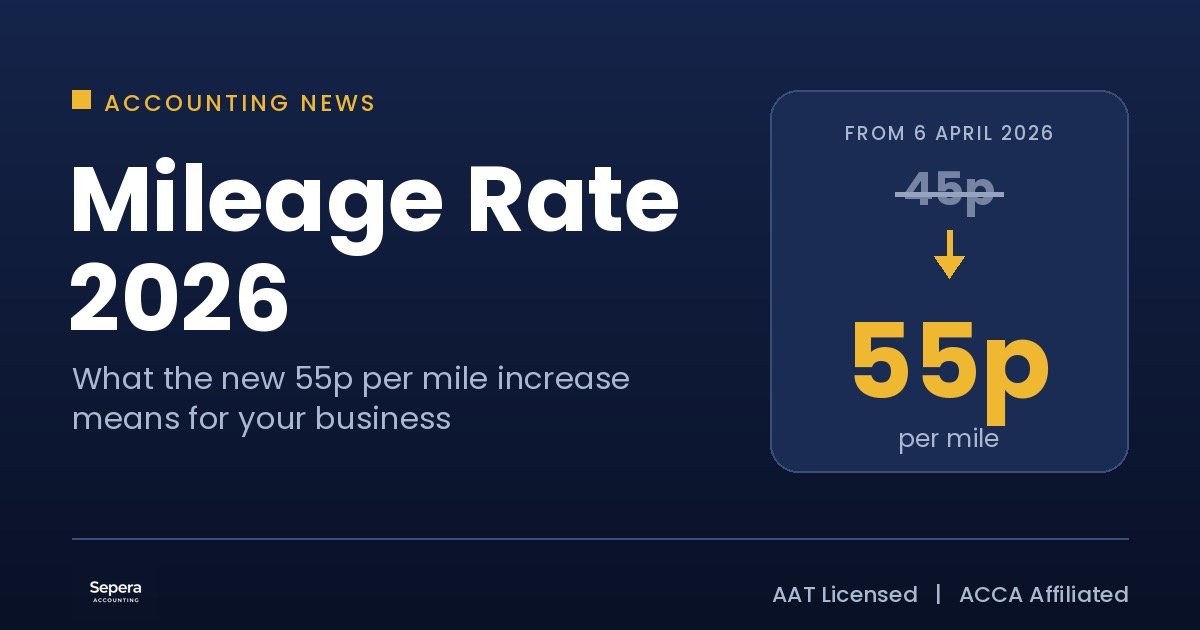
 The mileage rate 2026 update is welcome news for anyone who drives their own vehicle for work. For the first time in 15 years, the UK business mileage rate has gone up. On Thursday 21 May 2026, Chancellor Rachel Reeves announced that the approved rate is rising from 45p to 55p per mile, and the change has been backdated to the start of the current tax year in April.
At Sepera Accounting, we want every client to claim everything they are entitled to. Here is a plain-English guide to the mileage rate 2026 change, who it affects, and the simple steps to take so you do not miss out.
What the mileage rate 2026 change actually means
The rate in question is the Approved Mileage Allowance Payment, usually shortened to AMAP. It is the flat rate set by HMRC to cover the cost of using your own vehicle for business travel: fuel, insurance, servicing, repairs, and wear and tear all rolled into one figure.
The key points of the mileage rate 2026 announcement are straightforward:
- The rate for cars and vans has increased from 45p to 55p per mile for the first 10,000 business miles in a tax year.
- The increase has been backdated to April 2026, so it applies to the whole of the current 2026/27 tax year.
- This is the first rise since 2011, when the 45p rate was introduced. Years of inflation and rising motoring costs had steadily eroded its value, which is why the increase has been widely welcomed.
For a business owner driving 8,000 miles a year for work, the new rate is worth an extra £800 in allowable expenses compared with the old one. That is a meaningful difference at tax time.
Mileage rate 2026: what stays the same
It is just as important to know what has not changed:
- The higher-mileage rate is unchanged. Once you pass 10,000 business miles in a tax year, the rate for those additional miles remains 25p per mile.
- The AMAP system itself works exactly as before. You still multiply your business miles by the rate to work out your claim.
- Commuting still does not count. Travel between your home and a regular place of work is not business mileage and cannot be claimed. Qualifying journeys include visiting clients, travelling to temporary workplaces, attending training, and moving between business sites.
- Rates for motorcycles and bicycles were not confirmed as changing in the announcement. We always recommend checking the current figures on the official GOV.UK mileage and fuel allowances page before you file.
What the mileage rate 2026 means if you are self-employed
If you are a sole trader or freelancer, you can use the new 55p rate as part of HMRC’s simplified expenses method. Instead of keeping every fuel receipt and working out the business share of your motoring costs, you simply record your business miles and apply the flat rate.
That mileage claim is an allowable business expense. It reduces your taxable trading profit, which in turn lowers both your Income Tax and your Class 4 National Insurance bill. With the rate going up, the same journeys you have already made this tax year are now worth more against your tax.
One word of caution: the simplified method is not always the best option for every driver. If you run a higher-value vehicle or do very high mileage, claiming actual running costs and capital allowances can sometimes work out better. Once you choose a method for a particular vehicle, you must stick with it for as long as you use that vehicle in the business, so it is worth getting the decision right from the start. Our team can help you compare the two approaches.
What the mileage rate 2026 means if you are a limited company director
If you use your personal car for company business, your limited company can pay you the new 55p per mile, free of tax and National Insurance, for the first 10,000 miles. This is often a cleaner and more tax-efficient option than running a company car, particularly for directors of owner-managed businesses.
Because the increase is backdated to April 2026, any qualifying business journeys you have already made this tax year now qualify at the higher rate. It is a good moment to review your mileage records and make sure your director’s expense claims reflect the new figure.
What the mileage rate 2026 means if you employ staff
If your employees use their own vehicles for work, you can now reimburse them at up to 55p per mile for the first 10,000 miles with no tax or National Insurance to worry about, as long as you stay within the approved rate.
There is a practical point to act on here. If you have been paying staff the old 45p rate since April, you may wish to top up those earlier payments to the new rate. Many employers will want to update their internal mileage policy and payroll records so that everyone is reimbursed correctly for the full 2026/27 year. If you would like a hand reviewing this, our payroll support team can make sure your records and submissions are accurate.
How to make the most of the new rate
Whatever your situation, the single most important thing is good record keeping. To claim mileage, HMRC expects a reliable log of every business journey, showing the date, the destination, the reason for the trip, and the miles travelled.
A simple spreadsheet works perfectly well, and there are plenty of apps that track journeys automatically and separate business miles from personal ones. Good records do two jobs: they make sure you claim the full amount you are owed, and they give you the evidence you need if HMRC ever asks a question.
This is also a useful prompt to think ahead. With Making Tax Digital for Income Tax now in force for many sole traders, keeping your mileage organised throughout the year, rather than scrambling at the deadline, will make your filing far smoother.
Frequently asked questions
When did the mileage rate 2026 increase start? The increase was announced on 21 May 2026 and has been backdated to the start of the 2026/27 tax year in April 2026. It applies to the whole of the current tax year.
Does the new 55p rate apply to every mile I drive? No. The 55p rate applies to the first 10,000 business miles in a tax year. For any business miles above 10,000, the rate remains 25p per mile.
Can I claim mileage for driving to work? No. Ordinary commuting between your home and a regular workplace does not count as business travel. Only journeys made wholly for business reasons, such as client visits or travel to temporary sites, can be claimed.
I am self-employed. How do I claim the new rate? You claim mileage as an allowable expense on the self-employment pages of your Self Assessment tax return, or through your Making Tax Digital submissions. Multiply your business miles by the relevant rate and include the total.
Need help with the mileage rate 2026 change?
Tax rules change, and small details can make a real difference to your bill. Whether you are a sole trader, a limited company director, or an employer, Sepera Accounting can make sure you claim everything you are entitled to and stay fully compliant with HMRC.
As an AAT-licensed and ACCA-affiliated practice with over 30 years of combined experience, we take the worry out of tax so you can focus on running your business. Get in touch with our team for friendly, practical advice tailored to you.
This article is general guidance and reflects information available at the time of writing. Tax rates and rules can change, so please contact us for advice tailored to your circumstances.
1. What is the new mileage rate for 2026?
The new UK mileage rate for cars and vans is 55p per mile for the first 10,000 business miles in a tax year. It has increased from the previous rate of 45p per mile.
2. When does the 55p mileage rate apply from?
The 55p mileage rate applies from April 2026, as it has been backdated to the start of the 2026/27 tax year. This means qualifying business journeys made since April 2026 can use the new rate.
3. Who can benefit from the new mileage rate?
The new mileage rate can benefit sole traders, freelancers, limited company directors, employees, and employers where a personal vehicle is used for business journeys.
4. Does the 55p rate apply to all business miles?
No. The 55p rate applies only to the first 10,000 business miles in a tax year. Any business mileage above 10,000 miles remains claimable at 25p per mile.
5. What counts as business mileage?
Business mileage includes journeys made wholly for work purposes, such as visiting clients, travelling to temporary workplaces, attending training, or moving between business sites.
6. Can I claim mileage for commuting to work?
No. Ordinary commuting between your home and your regular workplace does not count as business mileage. HMRC does not allow mileage claims for normal journeys to and from work.
7. How do self-employed people claim the new mileage rate?
Self-employed people can claim mileage using HMRC’s simplified expenses method. They record their business miles, multiply them by the approved rate, and include the total as an allowable business expense.
8. What does the new mileage rate mean for limited company directors?
Limited company directors using their personal car for company business can be reimbursed up to 55p per mile for the first 10,000 business miles, free from tax and National Insurance.
9. What should employers do about the mileage rate increase?
Employers should update their mileage policies, payroll records, and expense processes. If staff have been paid at 45p per mile since April 2026, employers may wish to top up qualifying payments to 55p.
10. What records are needed to claim business mileage?
To claim mileage, you should keep a reliable log showing the date, destination, reason for the journey, and miles travelled. A spreadsheet or mileage-tracking app is usually suitable.