 Capital allowances are one of the most valuable and most underused reliefs available to UK businesses. They let you deduct the cost of equipment, machinery, and other qualifying assets from your taxable profits, often in full, in the year you buy them. For a business investing £50,000 in new equipment, correctly claimed capital allowances can mean a genuine reduction in your tax bill running into thousands of pounds.
Yet many sole traders and small limited companies either miss claims entirely or claim them incorrectly. At Sepera Accounting, we review capital allowances as standard as part of every set of accounts we prepare. This guide explains exactly how capital allowances work for 2025/26, what qualifies, and how to make sure you are claiming everything you are entitled to.
What Are Capital Allowances?
Capital allowances are a form of tax relief that let UK businesses deduct the cost of qualifying capital expenditure from their taxable profits. Unlike day-to-day running costs, which are deducted as normal business expenses, spending on assets that will benefit the business over several years, such as machinery, equipment, and vehicles, is treated differently for tax purposes.
Without capital allowances, the cost of a £20,000 piece of equipment would sit on your balance sheet and only reduce your profit gradually through depreciation, which is not itself tax deductible. Capital allowances solve this by giving you a specific, HMRC-approved way to claim tax relief on that spending, often immediately.
Capital allowances are available to sole traders, partnerships, and limited companies. For unincorporated businesses, they reduce your taxable income and therefore your income tax and Class 4 National Insurance. For limited companies, they reduce your profits chargeable to corporation tax.
The Annual Investment Allowance for 2025/26
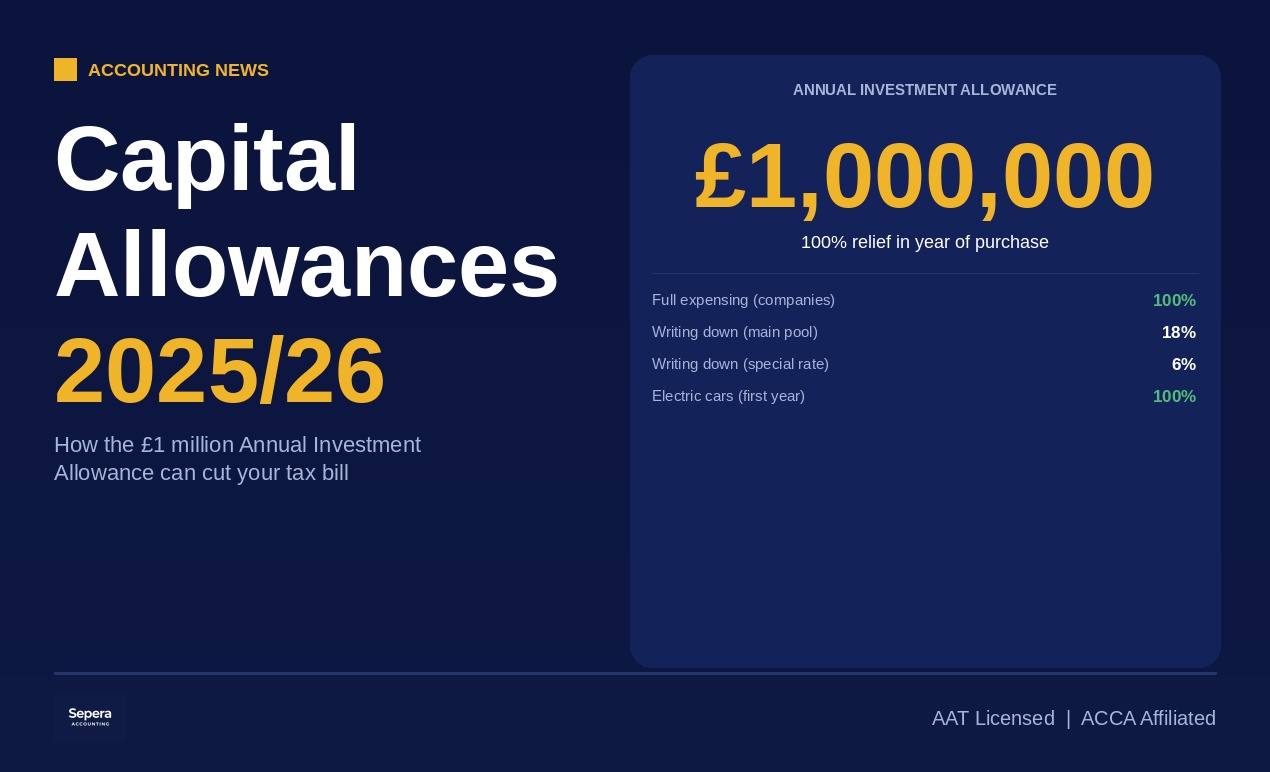
The main relief most businesses use is the Annual Investment Allowance (AIA). For 2025/26, the AIA is set at £1,000,000 per accounting period. This limit was made permanent in the Spring Budget 2023 after years of fluctuation, giving businesses long-term certainty for capital expenditure planning.
The AIA allows you to deduct 100% of the cost of qualifying plant and machinery from your taxable profits in the year of purchase, up to the £1 million limit. For the overwhelming majority of small and medium sized UK businesses, whose annual capital spending falls well below that threshold, this means equipment can be written off in full immediately rather than spread over several years.
If your accounting period is shorter or longer than 12 months, your AIA limit is prorated accordingly. A six-month accounting period, for example, gives an AIA limit of £500,000 rather than the full £1 million.
What Qualifies for Capital Allowances?
The AIA covers most plant and machinery used in your business. Common qualifying items include:
- Machinery and manufacturing equipment
- Computers, servers, and office IT equipment
- Office furniture and fittings
- Vans, lorries, and other commercial vehicles
- Tools and equipment used directly in the trade
- Integral features of a building, such as heating, lighting, lifts, and air conditioning systems
- Alteration costs required to install qualifying plant and machinery
Certain assets are excluded from the AIA entirely, most notably cars. Cars are treated under a separate set of rules based on CO2 emissions rather than the AIA. If your business is considering vehicle purchases, our guide on buying a car through a limited company covers how car capital allowances work in detail.
Full Expensing for Limited Companies
Alongside the AIA, limited companies have access to full expensing, which was made permanent from April 2023. Full expensing allows companies liable to corporation tax to claim 100% first-year relief on qualifying main-rate plant and machinery, with no upper limit on the amount claimed.
This is particularly valuable for larger companies whose capital expenditure exceeds the £1 million AIA limit, or for group companies where the AIA is already fully allocated elsewhere in the group. For special rate assets, a 50% first-year allowance applies instead of the full 100%.
Full expensing is not available to sole traders or partnerships. It applies exclusively to companies within the charge to corporation tax. Following the Autumn Budget 2025, some restrictions around leased assets were also revised, so if your business leases or hires out equipment, it is worth checking your eligibility with an accountant before assuming the relief applies.
Writing Down Allowances: What Happens Above the AIA Limit
Once you have used your full AIA entitlement, or if you are claiming on an asset the AIA does not cover, relief is instead given through Writing Down Allowances (WDA). Rather than 100% relief in one year, WDA gives you a percentage of the remaining asset value each year on a reducing balance basis.
There are two main pools for WDA purposes:
- Main pool: 18% per year, covering most machinery, equipment, and IT hardware
- Special rate pool: 6% per year, covering integral building features, long-life assets, and higher-emission cars
Assets are grouped into these pools rather than tracked individually, with the exception of assets that have significant private use, such as a car used partly for personal journeys, which is kept in a single-asset pool so the private use percentage can be applied correctly.
Capital Allowances on Company Cars and Electric Vehicles
Cars sit outside the AIA and full expensing rules entirely. Instead, the rate of relief depends on the vehicle’s CO2 emissions:
- Fully electric cars (0g/km CO2): 100% First Year Allowance
- Lower-emission cars (50g/km CO2 or below): main pool rate of 18% per year
- Higher-emission cars (above 50g/km CO2): special rate pool at 6% per year
This is one of the clearest tax incentives currently available for businesses to move toward electric vehicles, and it explains why so many limited company directors have switched their company car to fully electric in recent years. For a full breakdown of the wider tax implications, see our article on buying a car through a limited company.
How to Claim Capital Allowances
The claims process differs depending on your business structure.
Limited companies claim capital allowances on their Corporation Tax return (CT600), in the capital allowances section. This is submitted as part of your annual accounts and tax computation. Our limited company accounting service includes a full capital allowances review with every set of accounts.
Sole traders and partnerships include capital allowances in their self assessment tax return, under the capital allowances section. You will need to list each qualifying asset, its cost, and the amount being claimed, up to the £1 million AIA limit.
In both cases, keep receipts, invoices, and evidence of business use for every asset claimed. HMRC can request this documentation as part of a compliance check, and claims without supporting evidence are at risk of being disallowed.
Common Capital Allowances Mistakes
These are the errors we see most often when reviewing new clients’ historic accounts.
Missing installation and delivery costs. The cost of installing qualifying equipment, including delivery, assembly, and alteration costs needed to fit it, generally qualifies alongside the asset itself. These are frequently overlooked.
Claiming cars under the AIA. Cars never qualify for the Annual Investment Allowance. Claiming a car incorrectly under the AIA is a common and easily corrected error, but one that can trigger an HMRC enquiry if it is not fixed.
Poor timing of purchases. Because the AIA resets with each new accounting period, the timing of significant purchases around your year end can materially affect when relief is available. Spending £900,000 just before your year end followed by £300,000 just after can secure full relief on both amounts across two AIA periods, whereas combining them into a single period could push part of the spend into the lower-rate WDA pool.
Forgetting private use restrictions. For sole traders in particular, any asset with an element of personal use must have the allowance restricted to the business use proportion. A van used 90% for business only attracts 90% of the available capital allowances.
Planning Your Capital Expenditure Around Capital Allowances
Because capital allowances can accelerate tax relief significantly, timing genuine business investment decisions around your accounting period end can meaningfully improve your cash flow. This is not about buying equipment you do not need purely for tax purposes, but about being deliberate with the timing of purchases you were planning to make regardless.
If you are planning a significant equipment purchase, speak to your accountant before committing. The right timing, correct classification, and full documentation from the outset make the difference between a smooth, maximised claim and a missed opportunity.
How Sepera Accounting Helps With Capital Allowances
Capital allowances are reviewed as a standard part of every set of accounts we prepare, whether you are a sole trader, a growing limited company, or a landlord with a portfolio of properties. We identify every qualifying item, apply the correct pool and rate, and ensure your claim is fully documented and defensible if HMRC ever asks questions.
We are an AAT-licensed, ACCA-affiliated practice with over 30 years of combined experience supporting businesses across London and Stockport. Get in touch via our contact page or call us on +44 20 7071 8676 to discuss your upcoming capital expenditure plans.
You can also read HMRC’s official guidance on capital allowances at GOV.UK.
Frequently Asked Questions: Capital Allowances
What are capital allowances?
Capital allowances are a UK tax relief that lets businesses deduct the cost of qualifying capital expenditure, such as equipment and machinery, from their taxable profits. They are available to sole traders, partnerships, and limited companies, and reduce the tax due for the accounting period in which the claim is made.
What is the Annual Investment Allowance for 2025/26?
The Annual Investment Allowance for 2025/26 is £1,000,000 per accounting period. It allows 100% tax relief on qualifying plant and machinery expenditure up to that limit in the year of purchase. This figure was made permanent from April 2023.
Do cars qualify for capital allowances under the AIA?
No. Cars never qualify for the Annual Investment Allowance. Instead, car capital allowances depend on CO2 emissions, with fully electric cars qualifying for a 100% First Year Allowance, and higher-emission cars falling into the 6% special rate pool.
What is the difference between the AIA and full expensing?
The AIA is available to all business types and covers up to £1 million of qualifying expenditure per accounting period. Full expensing is available only to limited companies liable to corporation tax and has no upper limit, making it valuable for larger companies whose spending exceeds the AIA threshold.
What are Writing Down Allowances?
Writing Down Allowances apply once your AIA is used up, or to assets the AIA does not cover. They give a percentage of the remaining asset value each year, 18% for the main pool and 6% for the special rate pool, rather than 100% relief in a single year.
Can sole traders claim capital allowances?
Yes. Sole traders and partnerships can claim capital allowances, including the Annual Investment Allowance, on their self assessment tax return. The claim reduces taxable income, lowering both income tax and Class 4 National Insurance liability.
What qualifies as plant and machinery for capital allowances?
Qualifying plant and machinery includes manufacturing equipment, computers and IT hardware, office furniture, commercial vehicles, tools, and integral building features such as heating and lighting systems. Cars are specifically excluded from this category.
How do I claim capital allowances if I am a limited company?
Limited companies claim capital allowances on their Corporation Tax return (CT600), within the capital allowances section, as part of the annual accounts and tax computation submitted to HMRC.
Can the Annual Investment Allowance be carried forward if unused?
No. The AIA cannot be carried forward. It is a use-it-or-lose-it allowance for each accounting period. Unused AIA capacity does not roll into the following year, which makes purchase timing an important planning consideration.
What happens if my capital expenditure exceeds the AIA limit?
Any qualifying expenditure above the £1 million AIA limit is claimed instead through Writing Down Allowances, or through full expensing if you are a limited company. This gives relief over a longer period, or immediately in the case of full expensing, rather than in full in the year of purchase.
This article provides general guidance on capital allowances in the UK for 2025/26. Tax rules and rates can change. Please contact us for advice tailored to your specific circumstances.